
A Retrospective Announced, Then Withheld
1987–2012Anthology 1987–2012 was the first midcareer retrospective to withhold the career it surveyed — dispersing twenty-five years of work into a single reflective image, a catalogue, a film, a website, and the press — mounted under the signature of a living artist’s own Estate, one year after the market set a record price on the image it revised. The empty gallery has a lineage — Yves Klein’s Le Vide (Iris Clert, Paris, 1958), Robert Barry’s closed-gallery works (1969), Michael Asher’s removals (Claire Copley Gallery, Los Angeles, 1974) — but those works emptied an exhibition. Anthology emptied the retrospective itself, the genre whose entire function is accumulation and proof, and documented the dispersal as its actual form.
Anthology 1987–2012 was announced as a midcareer retrospective covering approximately twenty-five years of LG Williams’s practice. The Milan gallery did not contain a conventional chronological survey. The physical presentation was compressed into a single principal artwork, the otherwise empty gallery, a printed anthology, an online presentation, and the documentary machinery surrounding the exhibition.
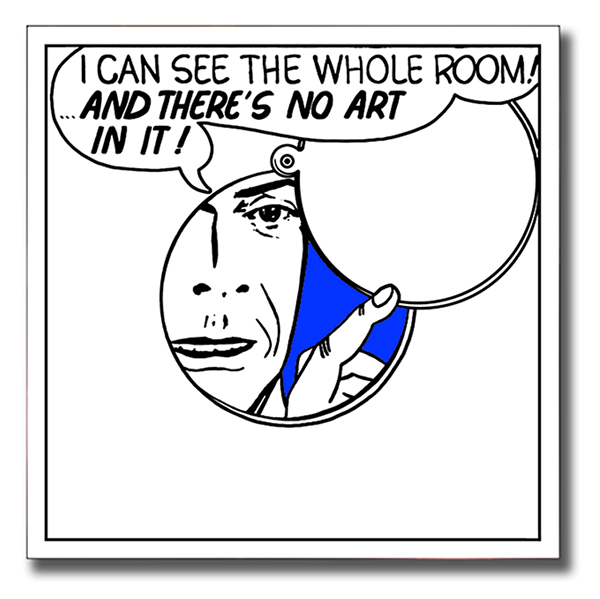
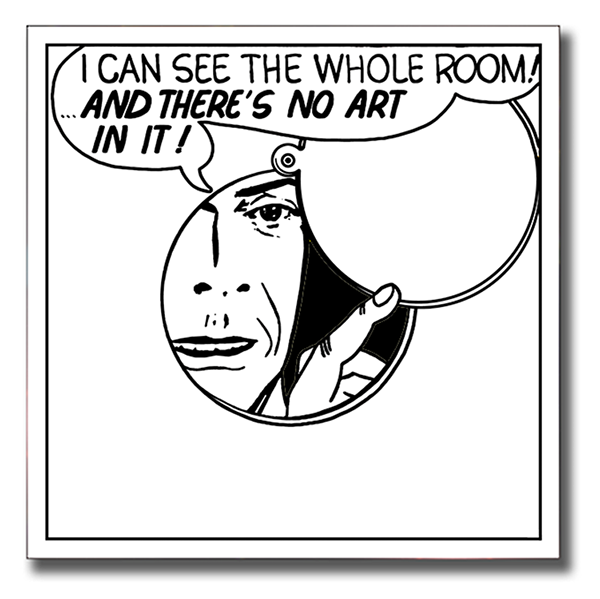
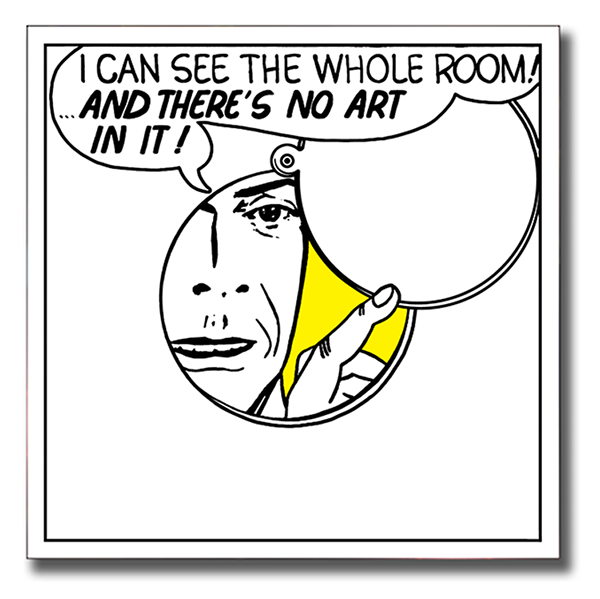
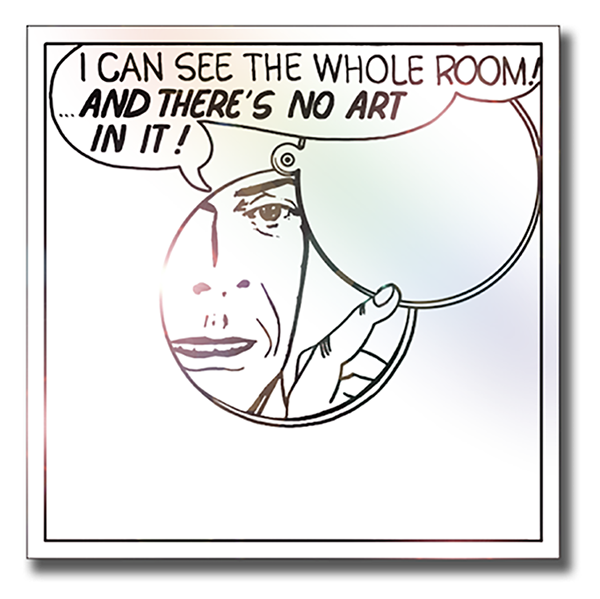
Gloria Maria Gallery, Milan, invited Baron Osuna and Super Window Project to present the retrospective from November 14 through December 21, 2012. Thomas Frangenberg wrote the catalogue essay; Baron Osuna designed the publication. The principal work was I Can See The Whole Room! And There’s No Art In It!
- Venue: Gloria Maria Gallery, Milan, Italy
- Address: Via Watt 32, 20143 Milano
- Dates: November 14–December 21, 2012
- Organizing context: Gloria Maria Gallery invited Baron Osuna and Super Window Project
- Catalogue essay: Thomas Frangenberg, University of Leicester
- Publication design: Baron Osuna
- Editorial / gallery: Gloria Maria Cappelletti
- Publisher / imprint: PCP Press (an imprint of The Estate of LG Williams™ and LGW Ventures LLC) / Super Window Project / Gloria Maria Gallery
- Catalogue: 72 pages, first PCP Press edition 2012
- ISBN: 9781545487730
- Principal work: I Can See The Whole Room! And There’s No Art In It! (White), 2011
- Medium: Vinyl and engineer-grade reflective sheeting on heavy-duty aluminum
- Dimensions: 122 × 122 cm / 48 × 48 inches
The exhibition title is itself unstable in the record. The catalogue’s cover reads 1987–2012, while its title page and Library of Congress data read 1981–2012; bibliographies later add 1985–2012. These variants are preserved here as project-record forms rather than silently resolved to a single date. The instability extends into the exhibition’s own apparatus: the catalogue essay is headed Anthology 1987–2012, while the Estate’s press and CV records attribute the same essay to Anthology: 1985–2012; and the essay dates the Lichtenstein record sale to 9 November 2011, where the contemporary Bloomberg report records the evening sale of 8 November. These splits are reported, not resolved.
The Apparatus of Total Vision
ReadingThe cartoon figure peers through an aperture and promises to see the whole room. The retrospective makes a parallel promise: to make a whole career visible. Neither promise can be kept from a single position.
The shutter through which the figure looks is positioned on the viewer’s own side, so he uses the device against its apparent design. The fitting itself, Frangenberg observes, is “evocative of a context of surveillance.” His raised finger crosses and obstructs his own field of vision. His failure is physical and epistemological at once: the “whole room” cannot actually be seen from where he stands, just as the “whole career” cannot be mastered through a single retrospective view.
“The fact that the exhibition presents itself as a survey spanning the past twenty-five years suggests that this particular work represents or embodies sufficient amounts of characteristics of all the other works so as to be able to stand in for them.”
Thomas Frangenberg, catalogue essay, 2012
This is the register the rest of the page works in: mediation, obstruction, institutional visibility, and the impossibility of a complete historical survey.
The Principal Artwork
2011I Can See The Whole Room! And There’s No Art In It! (2011) is vinyl and engineer-grade reflective sheeting on heavy-duty aluminum, 122 × 122 cm / 48 × 48 inches. Its Catalogue Raisonné record is the primary source for the work. In the catalogue essay, Thomas Frangenberg records its status directly: “It forms the only component of an exhibition at the Gloria Maria Gallery in Milan in November 2012, entitled Anthology 1987-2012.”
The protagonist declares that there is no art in the room. Frangenberg supplies the essay’s reversal: because the shutter opens from the viewer’s side, it is the viewer who is “rewarded with the very presence of art the absence of which the cartoon hero proclaims.” The consequence follows plainly: “The gallery’s empty white walls become an integral component of the art work.” The gallery ceases to function as a neutral container: the white cube becomes visible as an apparatus that grants or withholds artistic recognition.
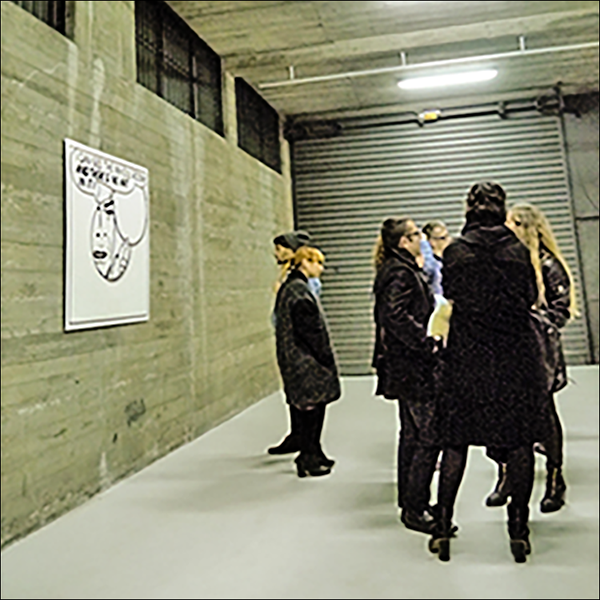
Where the Retrospective Actually Existed
Five Sites- Gallery
The embodied encounter and the apparent absence of objects.
- Artwork
The concentrated conceptual proposition.
- Catalogue
The visual and historical corpus of the retrospective.
- Website
The dispersed and potentially unlimited online presentation of the work.
- Press & Film
The public verification, circulation, and documentation of the event.
“An Antology [sic] 1987-2012 by LG Williams / The Estate of LG WIliams [sic] does nonetheless exist, but it does so in different ways. Within the factual, tangible walls of Gloria Maria Gallery it exists as part-fiction, whilst it has an intangible, but real existence in the form of a presentation on the internet.”
Thomas Frangenberg, catalogue essay, 2012 — transcribed verbatim, including the essay’s printed typographic errors
The catalogue functions as a principal exhibition site, not supplementary documentation. The film introduced below carries the exhibition’s moving-image evidence of physical and social existence.
Gloria Maria Gallery Invites Super Window Project & LG Williams
2012Moving-image documentation of Anthology 1987–2012, Gloria Maria Gallery, Milan, 2012.
The film records the exhibition in the medium through which its central paradox becomes clearest: a retrospective announced through a gallery whose apparent emptiness formed part of the work. It should be read alongside the catalogue, Thomas Frangenberg’s essay, the installation photographs, and the contemporary press record.
A Living Artist, Dead Since '92
Estate™The Estate of LG Williams™ is not simply a posthumous administrative body. It is an artistic construction operating during the artist’s lifetime. Artist and Estate appear together in the exhibition credit, manufacturing historical distance in advance: a living artist framed as already archival, authorship delegated to an institutional double.
The Estate is part of the work’s conceptual vocabulary — a structure that links absence, death, preservation, and retrospective authority into a single operating identity.
“Already in his name the artist presents us with a character half of which is fictionalized as a historical phenomenon that is now held in trust.”
Thomas Frangenberg, catalogue essay, 2012
Nobody, Substituted With No Art
1969 / 2011In November 2011, Williams attended the Christie’s contemporary-art auction in New York at which Roy Lichtenstein’s 1961 painting I Can See the Whole Room! … And There’s Nobody in It! sold for $43.2 million, then an auction record for the artist. Williams subsequently produced his 2011 version, changing “nobody” to “no art” — a substitution that shifts the question from human presence to artistic recognition.
The Bloomberg report confirms that the painting was the leading lot in Christie’s November 8, 2011 evening sale and sold for $43.2 million, establishing a record for Lichtenstein.
Williams’s version stages art that announces its own invisibility inside a gallery. The relationship connects appropriation, canon formation, market visibility, and institutional recognition. It should be read as a conceptual substitution rather than reduced to parody.
The Catalogue as Curatorial Argument
72 Pages
The complete 72-page anthology, designed by Baron Osuna, is treated here as a curatorial argument rather than a passive record: its sequence, pacing, use of full-page images and details, blank pages, and recurring media and motifs perform the retrospective as much as any single wall did. Publication credit: PCP Press / Super Window Project / Gloria Maria Gallery. ISBN 9781545487730.
A definitive work checklist will not be published until every catalogue caption has been reconciled with the artwork database and the Catalogue Raisonné. The date-range discrepancies — 1981–2012, 1985–2012, 1987–2012 — are preserved rather than silently resolved.
Selected plates from the catalogue


The Definitive Checklist
25 WorksThe catalogue’s checklist reproduces the retrospective as a set of twenty-five works spanning the period. Titles and media are transcribed here from the catalogue’s own list.
- 01
The Professional™
2012 · 87 × 96 in · House Paint on Canvas
- 02
Untitled Or Perhaps It Is Better To Say (Think Of It: I Just Love The Moments We Have Together) Or Driving Miss Daisy From The Mortuary [In A Hospital Or Elsewhere]
2010 · Dimensions variable · Vinyl and engineer-grade reflective sheeting on heavy-duty aluminum
- 03
The Inevitable (Happiness) — Yellow
2010 · 48 in diameter · Vinyl and engineer-grade reflective sheeting on heavy-duty aluminum
- 04
Raged Saged
1999 · 70 × 90 in · Mixed Media on Canvas
- 05
Two Triangles
1995 · 48 × 48 in · Vinyl and engineer-grade reflective sheeting on heavy-duty aluminum
- 06
The Professionals™
2012 · 62 × 109 in · House Paint on Canvas
- 07
How To Explain Art To The Sports Generation: Mona Lisa
2004 · 40 × 30 in · Vinyl and engineer-grade reflective sheeting on heavy-duty aluminum
- 08
Help Wanted Series
2004 · 24 × 18 in · OCE Print
- 09
Shark! or The Dominate Class of Thro or Thorniness Or Perhaps Impossibility
2009 · Dimensions variable · Band-Aid® on Wall
- 10
Eighteen — I Didn’t Want To Treat People Like That, I Wanted To Be Positive!, Or, Perhaps It Would Be Better To Say: “Do Not Assume My Predictions Will Be Wrong” (For PHD)
2012 · 72 × 90 in · Paint on Raw Canvas
- 11
Tape Drawing #18
2011 · Dimensions variable · Colored Tape on Wall
- 12
Conceptual Art #25 (Its All Fine By Me)
2012 · 60 × 84 in · Vinyl and engineer-grade reflective sheeting on heavy-duty aluminum
- 13
Crazy About You: Don’t Eat Fish While Crossing The Line Between Real Life And Entertainment With 8 Grams Of Cocaine, Zig Zag Wrappers And A Broken Tablet Of Albuterol
2010 · 40 × 60 in · Towel on Wall
- 14
The Gap #3 (While Some Of The Facts Are Still Being Gathered, It Appears That This Is Much Ado About Nothing. We Are Confident This Matter Will Be Cleared Up And The Claims [Against Lindsay, This, That Or Whatever] Will Be Proven Untrue.)
2012 · 96 × 96 in · Enamel on Canvas
- 15
White Flag
2009 · 24 × 27 in · Hefty® Tall Kitchen Garbage Bag on Wall
- 16
Positions That Are A Result Of Situations (Series)
2012 · 48 × 48 in · Vinyl and engineer-grade reflective sheeting on heavy-duty aluminum
- 17
Royds (Series)
2006 · 90 × 60 in · Vinyl and engineer-grade reflective sheeting on heavy-duty aluminum
- 18
A Recurring Role Or I Am SO Excited To Reveal To You All That I Am Going To Be Making My Acting Debut!! My Episode Will Air In October This Year …
2012 · 72 × 72 in · Vinyl and engineer-grade reflective sheeting on heavy-duty aluminum
- 19
What Was The Alternative? It Had To Be Done: That Is How The System Works, Or: You’re Like A Child (Performing Songs From Your Upcoming Christmas Album)
2010 · 14 × 10 in · Duct Tape on Wooden Cuckoo Clock
- 20
Flag (Harass The Neighbors, Eat Nachos And Everything Sucks — Except My Travel And Expense Account)
2011 · 48 × 96 in · 5/8 in Plywood on Wall
- 21
When The Event Happened…Shit, We Were Completely Terrified And Devastated!!! … (Angelina Jolie Was Here!)
2012 · 18 × 196 in · Lettering on Wall
- 22
LA Figure Painting: $45,345,907,567.00
2007 · 20 × 140 in · Spray Paint on Wall
- 23
Larry’s Dream or He Got Cheated (A Cruel 4 Billion?)
2012 · 72 × 72 in · Vinyl and engineer-grade reflective sheeting on heavy-duty aluminum
- 24
A Fine Line #18
1999 · 60 × 100 in · Mixed Media on Canvas
- 25
Close Tab
2012 · Dimensions variable · Vinyl and engineer-grade reflective sheeting on heavy-duty aluminum
The catalogue’s plate sequence corresponds to this checklist numbering. Where a plate crops or modifies a work to fit the publication, the plate is treated here as the catalogue’s own object rather than as a substitute for the artwork record.
Thomas Frangenberg’s Argument
2012Commissioned for the exhibition and published by Super Window Project and Gloria Maria Gallery on November 14, 2012, Thomas Frangenberg’s essay — “On the Anthology 1987-2012 by LG Williams / The Estate of LG Williams” — is the exhibition’s own intellectual apparatus, not later commentary: it was bound into the catalogue this page treats as a principal site, and it survives in the Estate’s Samizdat record and as Document 02 in the archive below. Its argument moves in a single arc: a close description of the cartoon hero at his shutter; the reversal by which it is the viewer, not the protagonist, who is rewarded with art; the artist’s name read as part person, part fictional character; the Lichtenstein auction; a lineage of works about looking, from Watteau to Wallinger; and the claim that the anthology existed simultaneously within the gallery and on the internet. It is the most-quoted document on this page — its sentences anchor §§ 02, 03, 04, 06, and the closing section — and this section treats the essay itself.
Thomas Frangenberg (Germany, 1957 – London, 2018; PhD, University of Cologne) taught art history at the University of Leicester from 1990 to 2017. His field was the beholder: Renaissance perspective theory, optical correction, the geometry of the glance — the scholarship of how pictures position an eye. Almost no one knew, while he lived, that he was also among Britain’s most serious private collectors of conceptual art; after his death, more than 750 works went to Wolfson College, Cambridge, with bequests to Tate and the Contemporary Art Society. The historian of the aperture — a man who kept his own collection out of sight — wrote the essay on a work about looking into a room said to contain no art.
Thomas Frangenberg’s essay situates the work within an art-historical sequence of viewing devices and vantage points, each establishing a distinct mode of looking.
- Watteau, L’Enseigne de Gersaint (1720), Charlottenburg, BerlinInspectionTwo figures closely inspect a painting shown to them.
- Anamorphic perspective boxesOptical correctionThe viewer must find the single point from which distortion resolves.
- Falconet, magic-lantern porcelain group (c. 1760)EntertainmentA girl peeks into a round opening to enjoy the spectacle inside.
- Bernini, Ecstasy of Saint Teresa (1652), Cornaro Chapel, RomeDevotionAn opening wide enough for a whole congregation to witness the vision.
- Duchamp, Étant donnés (1946–66), Philadelphia Museum of ArtVoyeurism / surveillanceA keyhole admits a single charged, private glance.
- Wallinger, Diana (2012), National Gallery, LondonRestricted accessA broken window pane grants a furtive, partial view.
“As we return the glance across the protagonist’s index finger, our corporeal eyes are engaged as fruitfully as the eyes of our mind.”
Thomas Frangenberg, catalogue essay, 2012
Donald Preziosi
2013 / 2014 / 2018
Donald Preziosi is Professor Emeritus of Art History at UCLA and was Slade Professor of Fine Art at Oxford (2000–01). Rethinking Art History: Meditations on a Coy Science (1989) and The Art of Art History made him the discipline’s foremost analyst of how museums and art history manufacture their objects. The theorist of the museum’s authority chose, as his analytical object, the exhibition that withheld the museum’s proof.
Donald Preziosi returned repeatedly to I Can See The Whole Room! And There’s No Art In It! across a 2013 lecture, his 2014 Routledge book Art, Religion, Amnesia: The Enchantments of Credulity, and his 2018 chapter in Global and World Art in the Practice of the University Museum. Rather than citing the work in passing, Preziosi used it as an analytical object through which to examine visibility, belief, spectatorship, institutional authority, and the production of meaning. His engagement did not begin in Milan: the 2014 chapter records that he first encountered the image as an online announcement for the In Absentia presentation at ART-O-RAMA, Marseille, circulating in late summer 2012 — the scholarly reception itself arrived through the work’s internet circulation.
-
October 19, 2013
Donald Preziosi, “In the Light of the Fowler: Art History, Museology, and…”
Art Historians of Southern California Symposium, Fowler Museum, UCLA. The first documented public presentation in which Preziosi developed ideas later published in book form.
In Art, Religion, Amnesia (2014), Williams’s work opens Preziosi’s discussion, forming the first element of a three-image sequence alongside an East Boulder Baptist Church sign and the Christ statue at Świebodzin, Poland. Preziosi is not discussing Pop Art or appropriation; he uses the work to investigate how meaning, visibility, belief, and recognition are produced.
“the indispensible role of the spectator in the carpentry of signification”
Donald Preziosi, Art, Religion, Amnesia (Routledge, 2014), p. 89; the work is discussed at pp. 84–85 and 89–90
Preziosi returned to the artwork four years later. It appears as Figure 2.1 opening his chapter in Global and World Art in the Practice of the University Museum (2018), where it functions within a discussion of museums, art history, classification, institutional authority, and the production of cultural value — continuing scholarly engagement rather than a single isolated citation.
The International Network
2010–2012The retrospective mirrored the conditions through which the work had become visible: dispersed, mobile, mediated, and sustained by project spaces, fairs, publications, personal networks, and international circulation.
- 2010–2011
Closed
Super Window Project, Kyoto · Nov 15, 2010–Jan 9, 2011
- 2011
In Absentia
Super Window Project, Kyoto · Feb 7–Mar 6, 2011
- 2011
Salaryman / Superman
Tana Bookshelf Gallery, Tokyo · Feb 3–6, 2011
- 2011
Art Cologne
Super Window Project with LG Williams · Apr 13–17, 2011
- 2011
Anything But
The Container, Tokyo · Jun 6–Aug 30, 2011
- 2011
Artissima 18
Super Window Project with Soshi Matsunobe, Sandrine Pelletier, and LG Williams · Nov 4–6, 2011
- 2012
ARCO Madrid
Super Window Project with LG Williams · Feb 13–17, 2012
- 2012
ART-O-RAMA, Marseille
Super Window Project with LG Williams · Aug 31–Sep 16, 2012
- 2012
Trans Art Tokyo
The Container with LG Williams · Oct 21–Nov 25, 2012
- 2012
Artissima 19
Super Window Project with LG Williams · Nov 9–11, 2012
- 2012
Anthology 1987–2012
Gloria Maria Gallery, Milan · Nov 14–Dec 21, 2012
- 2013
Closed
Gloria Maria Gallery, Milan · Sep 19–Nov 17, 2013
Coverage as Completion
20 EntriesCoverage returned again and again to the exhibition’s central question of existence and visibility: a gallery that appears empty, a figure announcing that no art is present, and a catalogue, film, and press archive insisting that the event did occur.
“The more physically absent the retrospective became, the more it depended upon publication, citation, reproduction, film, and report.”
- Nov 19, 2012
- Nov 18, 2012
- Nov 17, 2012
- Nov 16, 2012
- Nov 16, 2012
- Nov 14, 2012
- Nov 14, 2012
- Nov 11, 2012
- Nov 15, 2012
- Oct 16, 2012
- Oct 12, 2012
- Oct 12, 2012
Mousse Magazine #35 · Context
LG Williams / The Estate Of LG Williams at Artissima 2012 & Gloria Maria Gallery
- Sep 6, 2012
- Sep 1, 2012
- Aug 31, 2012
- Aug 30, 2012
- Mar 16, 2012
- Feb 20, 2012
- Feb 2012
- Jan 2013
Consolidating the Narrative
2013–2026Gloria Maria Gallery hosted Closed in 2013; Java Magazine profiled Williams that January. Later bibliographic and CV references consolidated Anthology into the artist’s international midcareer narrative, and the Estate, publication, and archival strategies established in 2012 continued.
- 1987
Beginning of the period represented by the dominant exhibition title.
- 2010
Closed at Super Window Project, Kyoto.
- Feb 2011
In Absentia at Super Window Project, Kyoto.
- Apr 2011
Art Cologne with Super Window Project.
- Jun–Aug 2011
Anything But at The Container, Tokyo.
- 2011
Creation of I Can See The Whole Room! And There’s No Art In It!
- Oct 2013
Donald Preziosi presents on the work at the Fowler Museum, UCLA.
- Feb 2012
ARCO Madrid with Super Window Project.
- Aug–Sep 2012
ART-O-RAMA, Marseille.
- Oct–Nov 2012
Trans Art Tokyo.
- Nov 9–11, 2012
Artissima 19, Torino.
- Nov 14, 2012
Anthology opens at Gloria Maria Gallery, Milan.
- Nov 14–19, 2012
Main press cluster.
- Dec 21, 2012
Exhibition closes.
- Jan 2013
Java Magazine profile.
- 2014
Donald Preziosi, Art, Religion, Amnesia (Routledge), opens with the work.
- 2018
Donald Preziosi, Global and World Art in the Practice of the University Museum (Routledge), Figure 2.1.
- Sep–Nov 2013
Closed at Gloria Maria Gallery.
- 2013 / later
Bibliography increasingly uses both 1985–2012 and 1987–2012.
- 2014
Frangenberg essay appears in the current Samizdat publication record.
- 2026
This archival landing page consolidates the exhibition, publication, images, press, Catalogue Raisonné records, and documentary sources.
The Sixth Site
2012 → 2026Anthology closed on December 21, 2012. Its sites did not. The catalogue remains in circulation; the film continues to play; the press record continues to be archived and cited; Preziosi’s chapters carried the work into the scholarly literature through 2018 — an engagement that itself began not in the gallery but with the image circulating online. The exhibition anticipated a condition that has since become general: events that exist primarily as their documentation, and presence established through circulation rather than physical encounter.
“Visits to the website and to the gallery do not mutually make one another obsolete – rather, they set up a dialogue between the two modes of presentation.”
Thomas Frangenberg, catalogue essay, 2012
This page is the newest party to that dialogue — the sixth site of a retrospective dispersed by design, after the work, the book, the film, the press, and the website of 2012. It inherits the record as the record stands: three date ranges, a checklist that does not list the principal work under its principal title, plates altered by declaration, an essay whose title the Estate’s own citations render two ways. Frangenberg accounted for this condition at the time — the anthology “conforms with reality, and opposes itself to it in the guise of fiction at the same time” — and the discrepancies are accordingly reported here, not resolved. Their persistence is the work still functioning.
Primary Document Archive
25 Items- 01Complete Anthology catalogue (PDF — pending upload)
- 02Thomas Frangenberg essay PDF
- 03Moving-image documentation: Gloria Maria Gallery Invites Super Window Project & LG Williams, 2012. Vimeo video 53600951.
- 04Samizdat essay record
- 05Original 2012 Samizdat project record
- 06Original project email
- 07PCP Press catalogue record
- 08Apple Books record
- 09Catalogue Raisonné principal record
- 10Art Tribune PDF
- 11Purple Diary PDF
- 12Art Text Pics PDF
- 13Glass Magazine PDF
- 14Seeking People PDF
- 15Yiaos PDF
- 16Graza / Artissima PDF
- 17TYO Magazine PDF
- 18ArtInfo / Baron Osuna interview PDF
- 19ART-O-RAMA catalogue
- 20ART-O-RAMA web screenshot
- 21Java Magazine
- 22Bloomberg — Roy Lichtenstein Peephole Sets $43 Million Record at Christie’s. Katya Kazakina and Philip Boroff · November 8, 2011. Contemporary report documenting the Christie’s sale of Lichtenstein’s painting for $43.2 million.
- 23Donald Preziosi, Art, Religion, Amnesia: The Enchantments of Credulity (Routledge, 2014) — PDF
- 24Donald Preziosi, Global and World Art in the Practice of the University Museum (Routledge, 2018) — excerpt PDF
- 25Art, Religion, Amnesia — book information (Amazon)
LG Williams / The Estate of LG Williams™. Anthology 1987–2012. Gloria Maria Gallery, Milan, November 14–December 21, 2012. Organized with Baron Osuna and Super Window Project. Catalogue essay by Thomas Frangenberg. Exhibition catalogue, PCP Press / Super Window Project / Gloria Maria Gallery.
LG Williams / The Estate of LG Williams™. “Anthology 1987–2012: Midcareer Retrospective at Gloria Maria Gallery, Milan.” LGWilliams.com. Archival project overview and citation hub. https://lgwilliams.com/anthology-1987-2012/