Project/1999/Sculpture · Performance · Accidental Recycling
Party Down
A 1999 sculpture and drinking performance accidentally recycled before exhibition—then reconstructed through front-page news, public response, television, and the archive.
The Artwork That Entered the Recycling Stream
1999 · SCULPTUREIn September 1999, Williams prepared Party Down for a faculty exhibition at the Oliver Art Center Gallery, California College of Arts and Crafts, Oakland. Before the planned unveiling, a custodian mistook the work for trash and recycled it.
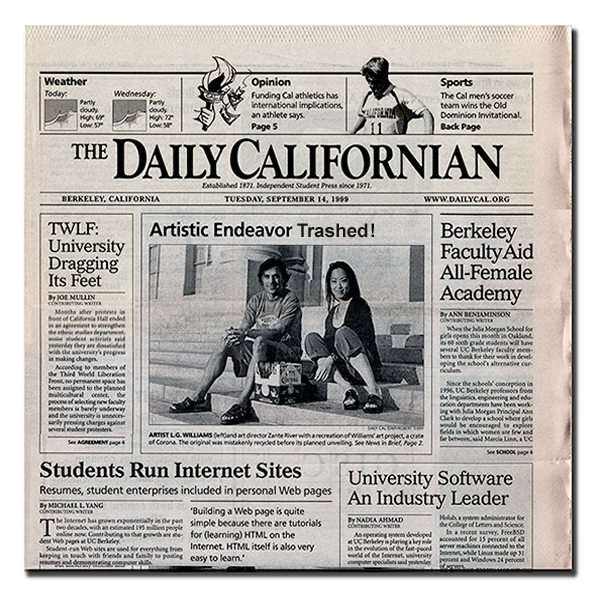
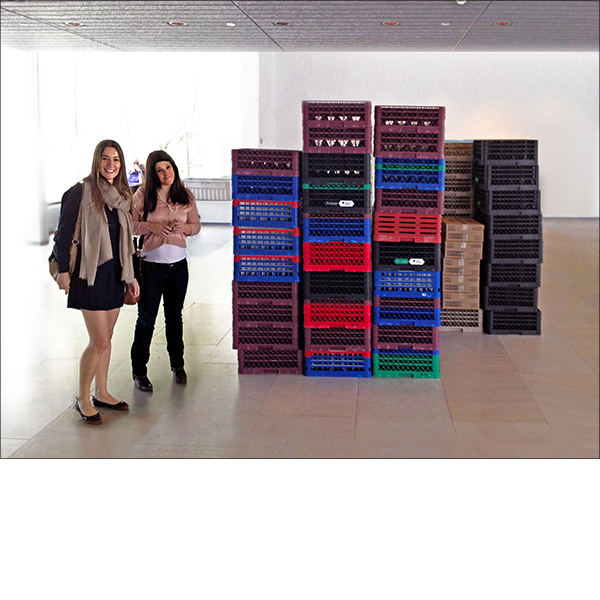
Williams produced a replacement. The Daily Californian reported the loss and the reconstruction on its front page on September 14, 1999, in a story headlined "Artistic Endeavor Trashed!" — the photograph accompanying it shows the reconstruction, not the original.
The photograph's printed caption identifies the woman pictured with Williams as Zante River (later known as Betty Fu), the exhibition's art director. This page uses Fu's name from this point forward.
Twelve Beers and the Remains of an Afternoon
PROCESSWilliams developed Party Down after a visit to Chicago, drawn to the drinking culture of friends there. The idea was not an empty twelve-pack as a found object — it was that drinking the beer would constitute the work's production.
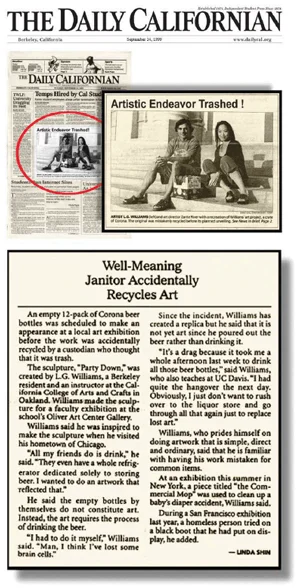
Daily Californian, September 14, 1999"The bottles by themselves weren't the piece," Williams told the paper. "Drinking them was."
Linda Shin, "Well-Meaning Janitor Accidentally Recycles Art," The Daily Californian, September 14, 1999.
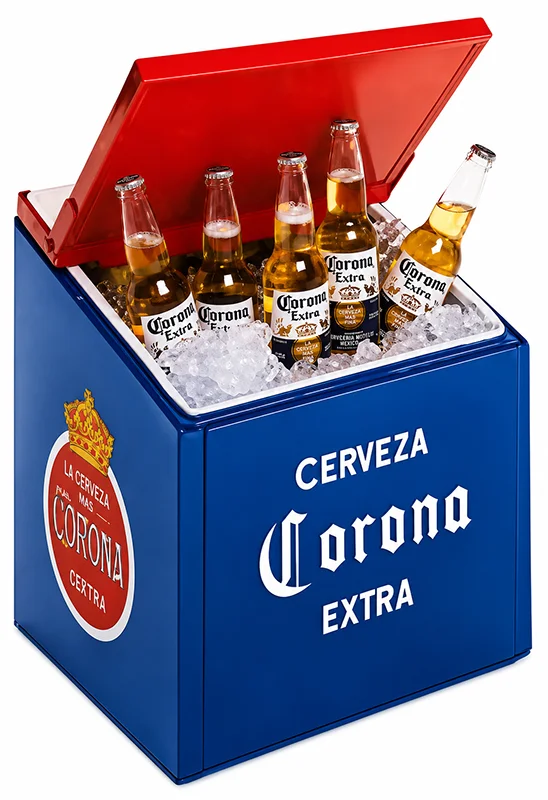
Williams drank the twelve beers over an afternoon and reported a hangover the next day. The emptied bottles, carton, ice, and cooler were arranged and designated for exhibition — the sculpture was the residue of a completed act, not a purchased assembly.
The article notes Williams was already familiar with his work being mistaken for ordinary objects — a pattern this page returns to in § 07.
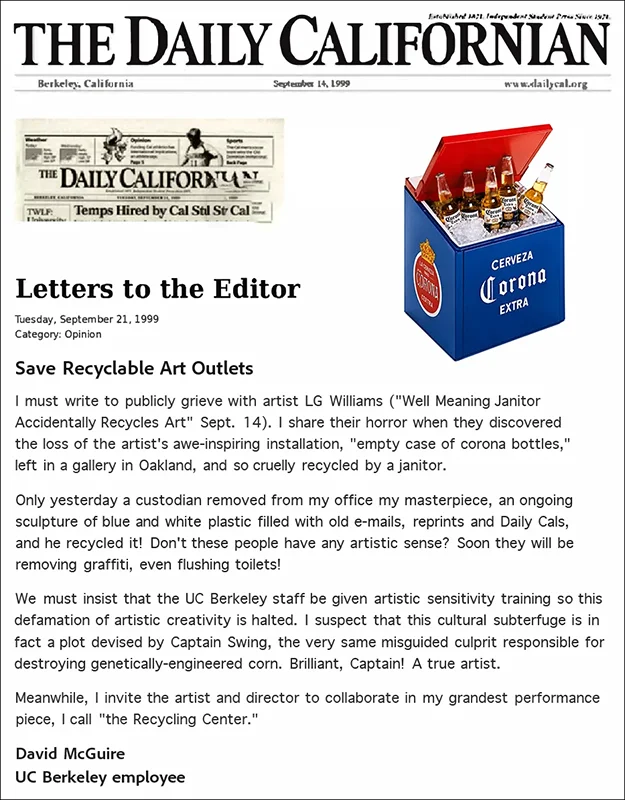
"I share their horror when they discovered the loss of the artist's awe-inspiring installation…"
David McGuire, "Save Recyclable Art Outlets," The Daily Californian, September 21, 1999. The letter shows Party Down generated immediate public response rather than remaining only a news item.
Well-Meaning Janitor Accidentally Recycles Art
PRIMARY DOCUMENTLG Williams · Party Down · 1999 · 18 × 18 × 18 inches · Twelve bottles of Corona, ice, and cooler.
Before the planned unveiling, a custodian at the Oliver Art Center Gallery cleared the space, mistook the arranged bottles and carton for trash, and recycled them. The Daily Californian reported the story on its front page, under the headline "Artistic Endeavor Trashed!"
The article (September 14) describes the custodian as well-meaning, not careless. This page follows that framing: the materials were genuinely recyclable, and the institution had not communicated their designated status to everyone responsible for the space.
What remains undocumented: whether the custodian was employed by the college, the gallery, or an outside contractor, and which components — bottles, carton, cooler, or ice — were actually recycled.
A LATER PARALLEL — OCTOBER 2001In October 2001, a cleaner at London's Eyestorm Gallery discarded an installation by Damien Hirst after mistaking it for rubbish. The incident was quickly absorbed into international art-world folklore. Party Down had already produced the same collision between artwork, waste, labor, and institutional recognition roughly two years earlier—and had already been documented in newspapers, the art press, and television. The parallel is chronological, not causal. But the disparity is unmistakable: when the incident attached itself to Hirst, the art world remembered it; when it happened to Williams first, the record was left scattered at the margins.
Hirst inherited the anecdote. Williams made the precedent.
Why Pouring Out the Beer Was Not Enough
AUTHENTICITYAt the time of the newspaper article, the replacement was not yet complete — its beer had been poured out rather than consumed. Williams distinguished the two objects on that basis. The archive now separates the work into three categories.
Original Party Down
Made through drinking; accidentally recycled before exhibition. Does not survive.
Replica / Reconstruction
Assembled after the loss, pictured in the September 1999 photograph. Its beer was poured out, not drunk — appearance without process.
Documentary Party Down
The photographs, newspaper article, public letter, television documentation, and later references — the form in which the work most fully survives.
Who Was Told That It Was Art?
INSTITUTIONAL READINGThe custodian correctly recognized what the materials were: recyclable packaging and consumed bottles. The gallery had assigned them a further status — artwork — without successfully communicating that status to everyone responsible for the space.
Read this way, the incident is not a joke about a worker failing to recognize art. It is a case of institutional communication failing to reach the labor hierarchy it depended on — artistic labor authorized as exhibition, custodial labor expected to clear the room of exactly the kind of residue the artwork was made of.
From Campus Front Page to Art Press and Television
1999-
Sep 14, 1999
The Daily Californian — Linda Shin, "Well-Meaning Janitor Accidentally Recycles Art"Front-page primary account.
-
Sep 14, 1999
San Francisco Chronicle — Rob Morse, "The Economy Is Just a Dirty Trickle"Regional commentary, published the same day.
-
Sunday, September 19, 1999
San Francisco KGO-TVParty Down was featured during KGO-TV's Sunday news broadcast, immediately before the station's football sports report covering that day's San Francisco 49ers game against the New Orleans Saints. The placement carried the work from newspaper and art-press coverage into mainstream Bay Area television news.
-
Sep 21, 1999
The Daily Californian — David McGuire, letter, "Save Recyclable Art Outlets"Public response to the original report.
-
Nov 1999
Artweek — Rob D'Amico, "In the News: Sculpture Tragedy"The story moves from daily news into the professional art press.

The Commercial Mop and the Black Boot
CAREER PATTERNThe 1999 article states that Williams was already familiar with his work being returned to ordinary use. It names two precedents.
The Commercial Mop
Used to clean a baby's diaper during a New York exhibition the summer before the Party Down report. Title, venue, and full catalogue record remain to be confirmed.
The Black Boot
Tried on by a homeless visitor during a San Francisco exhibition the previous year — recognized as wearable property rather than sculpture.
How Party Down Reentered the Practice
2002–2019A 2002 open letter to Transportation Secretary Norman Mineta cites the sculpture as evidence of Williams's visibility in the press and on television. A 2009 press release for the Band-Aids works calls Party Down "infamous" and reuses a quotation first associated with it. The 2019 Don't Look at That Tree release places Party Down alongside How to Explain Art to the Sports Generation, Angelina Jolie Was Here!, and ME as an experiential work defined by subversive ingenuity.
In 2013, Williams revisited the material directly: Party Down (Well, Almost): The Red Carpet Report Or, Hay Stranger! Check Out My Sexy Hot Tub! extends the 1999 sculpture's mythology into a later, self-authored register.
1999–2026
CONDENSED- Sept. 1999
Williams drinks twelve Coronas over an afternoon and prepares Party Down for the Oliver Art Center faculty exhibition. The work is recycled before its planned unveiling and then reconstructed.
- Sept. 14, 1999
The Daily Californian publishes Linda Shin's front-page report. The San Francisco Chronicle publishes Rob Morse's commentary the same day.
- Sept. 19, 1999
KGO-TV features Party Down during its Sunday news broadcast, immediately before the station's football report covering the San Francisco 49ers–New Orleans Saints game.
- Sept. 21, 1999
The Daily Californian publishes David McGuire's letter, "Save Recyclable Art Outlets."
- Nov. 1999
Artweek publishes Rob D'Amico's "In the News: Sculpture Tragedy."
- 2002
Open letter to Transportation Secretary Norman Mineta cites the sculpture as evidence of press and television visibility.
- 2009
Band-Aids press release calls the work "infamous" and reuses one of its quotations.
- 2013
Williams revisits the project's mythology in Party Down (Well, Almost): The Red Carpet Report Or, Hay Stranger! Check Out My Sexy Hot Tub!
- 2019
Don't Look at That Tree release positions Party Down among experiential works defined by subversive ingenuity.
- 2026
Catalogue Raisonné preserves separate records for the sculpture, newspaper cover, article, and KGO-TV documentation.
Primary Documents and Citation
SOURCE LEDGER- Party Down — image asset; related Catalogue Raisonné entry: Cat. No. LGW-1999-12-01a↗︎
- San Francisco KGO-TV — image asset; related Catalogue Raisonné entry: Cat. No. LGW-1999-12-01d↗︎
- Party Down (Well, Almost): The Red Carpet Report, 2013 — image asset; related Catalogue Raisonné entry: Cat. No. LGW-2013-32-01↗︎
- The Daily Californian, Sept. 14, 1999 — full facsimile PDF↗︎
- The Daily Californian — front-page cover image, Sept. 14, 1999↗︎
- The Daily Californian — article image, Sept. 14, 1999↗︎
- Rob Morse, "The Economy Is Just a Dirty Trickle," San Francisco Chronicle, Sept. 14, 1999
- David McGuire — "Save Recyclable Art Outlets," The Daily Californian, Sept. 21, 1999↗︎
- Rob D'Amico, "In the News: Sculpture Tragedy," Artweek, Nov. 1999
- San Francisco KGO-TV, Party Down television documentation, September 19, 1999
- Press and bibliography↗︎
- CV↗︎
The original sculpture does not survive. What remains are the reconstruction, photographs, newspaper coverage, a public letter, television documentation, later reinterpretations, and the archive itself. The documentary record is no longer merely evidence of Party Down; it is one of the principal forms through which the work continues to exist.
LG Williams / The Estate of LG Williams, Party Down, 1999.
LG Williams, "Party Down," project overview and archive, 1999–2026, LG Williams / The Estate of LG Williams, https://lgwilliams.com/party-down/. Accessed [Month Day, Year].