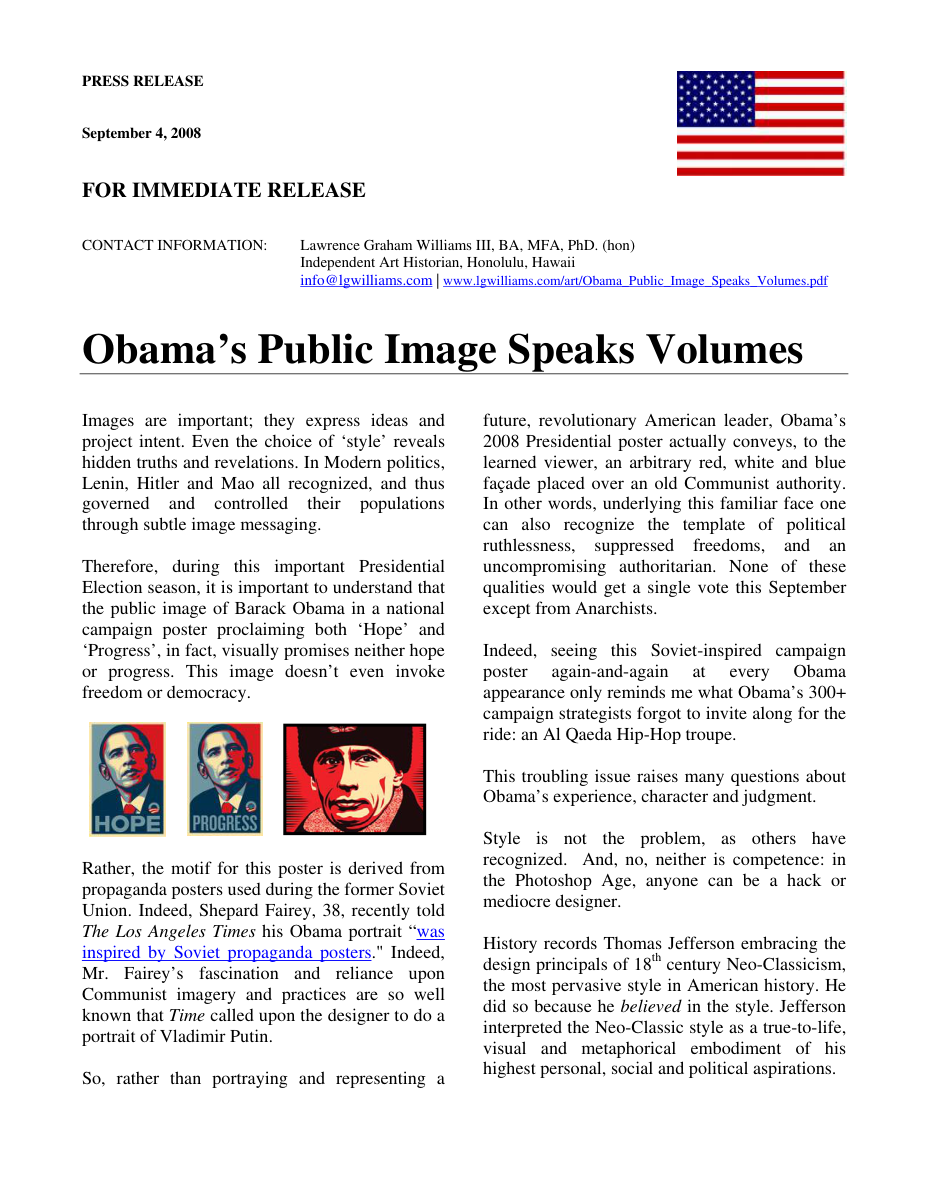
Obama's Public Image (In Hope Poster) Speaks Volumes
This essay attacks the Obama Hope poster as a failure of political iconography and a dangerous triumph of visual illiteracy. Williams argues that Shepard Fairey's image does not promise hope, progress, freedom, or democracy, but repackages Soviet propaganda style under a red-white-and-blue American skin. The polemic is less about partisan preference than about the politics of style: Jefferson's neoclassicism is invoked as an example of a visual language aligned with belief, while Fairey's borrowed revolutionary graphics are treated as counterfeit authority. The essay's ferocity comes from insisting that images have consequences and that political campaigns cannot outsource symbolism to an artist whose practice is accused of plagiarism and authoritarian nostalgia. It is art criticism as civic alarm, demanding that voters learn to read pictures before pictures learn to govern them.
- DATE:
- September 14, 2008
- DOCUMENT TYPE:
- Essay / Critique
- NAMED ARTISTS / FIGURES:
- LG Williams; Barack Obama; Shepard Fairey; Vladimir Putin; Thomas Jefferson; Jeremiah Wright; Steven Heller; Mark Vallen; Jay L. Clendenin
- INSTITUTIONS / VENUES:
- Los Angeles Times; Time; Democratic National Committee; Jonathon LeVine Gallery; New York Times
- KEYWORDS:
- Obama Hope as Soviet pastiche; Fairey propaganda lineage; visual illiteracy as political danger; Jefferson neoclassicism as counter-model; images having consequences; civic alarm through art criticism; plagiarism and authoritarian nostalgia; political iconography failed