Project/2004–2025/Artwork · Visual Literacy · Lectures · Publications
How to Explain Art to the Sports Generation
Mona Lisa · Picasso · Duchamp · ET AL · 2004–2025
Developed alongside Ralph Nader and LG Williams's 2004 essay If Only Art Lovers Were as Diligent as Sports Fans, the project redirects the analytical habits of sports culture toward art, transforming canonical artworks into tactical fields of movement, conflict, performance, and judgment.
What If Art Lovers Were as Diligent as Sports Fans?
2004 · PROJECTArt for the Sports Generation begins with a simple but far-reaching question: what would happen if art were studied, debated, remembered, and judged with the same intensity routinely brought to sports?
Developed alongside Ralph Nader and LG Williams's 2004 essay If Only Art Lovers Were as Diligent as Sports Fans, the project redirects the analytical habits of sports spectatorship toward art. Sports audiences read formations, retain histories, assess performance, assign responsibility, debate strategy, and demand accountability; Williams treats those capacities not as evidence of cultural limitation, but as a sophisticated form of visual and interpretive intelligence that art institutions have largely failed to address.
Using arrows, routes, Xs, Os, and tactical formations, the project transforms canonical artworks into active fields of movement, opposition, consequence, and judgment. Its first documented works apply this method to Leonardo's Mona Lisa, Picasso's Les Demoiselles d'Avignon, and Duchamp's urinal, moving across three related questions: how an image directs perception, how a painting organizes conflict, and how the art world determines what counts as art.
The project does not simplify art for sports audiences. It recognizes that they already know how to look. Mona Lisa becomes its longest and most developed case study — Leonardo's portrait remapped as a playing field, returned to across two decades of lectures, analysis, and extension.

The Demand for Artistic Accountability
RALPH NADER & LG WILLIAMS · 2004Published on November 15, 2004, Tolerating a No Fault Artistic Accountability: If Only Art Lovers Were as Diligent as Sports Fans, by Ralph Nader and LG Williams, supplies the conceptual charter for How to Explain Art to the Sports Generation.
The essay's argument is one of performance standards: sports culture holds athletes, coaches, and organizations to a public standard of memory, strategy, and accountability that art audiences rarely extend to artists, curators, dealers, museums, and cultural institutions. Williams translates that argument into visual form — the playbook arrows, Xs, Os, routes, and formations mapped across each work are not decorative additions, but a direct transposition of the essay's criticism of institutional accountability into the act of looking.
Project propositionArt for the Sports Generation asks viewers to bring the same memory, tactical intelligence, criticism, and sustained attention to artworks that sports fans bring to the playing field.
The original illustrated PDF reproduces three works from the series: Mona Lisa, Picasso, and Duchamp. It should be treated as both a foundational essay and a primary visual document for the project.

Mona Lisa · Picasso · Duchamp AND MORE!
2004 · FOUNDING WORKSThe 2004 essay's illustrated document reproduces three works, each testing the sports-diagram method against a different question about art.
Mona Lisa
2004–05 · 40 × 30" · Vinyl and Engineer Grade Reflective Sheeting on Heavy-Duty Aluminum
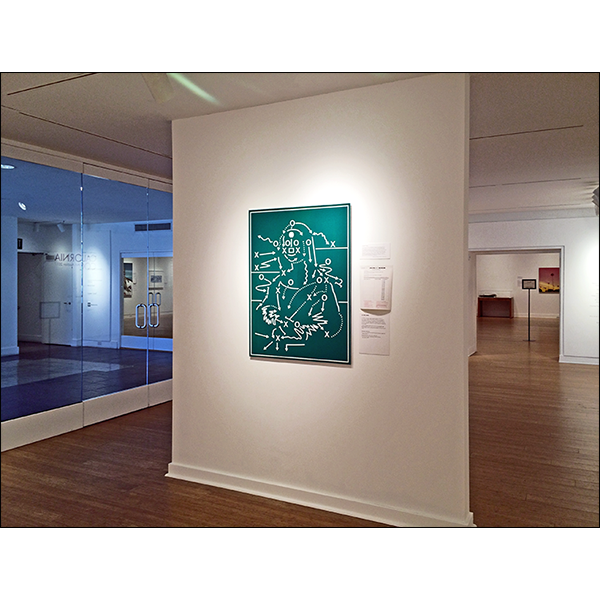
Perception, expression, and directional force: Leonardo's portrait remapped as a field of routes and arrows converging on the smile.
Catalogue record ↗︎
Duchamp / The Urinal
2004 · Documented in the original illustrated project essay, 2004.
Designation, authorship, institutional rules, and the question of what counts as art: the diagram is applied not to a painted image but to the readymade's founding act of institutional selection.
Picasso / Les Demoiselles d'Avignon
2004 · 60 × 60" · Vinyl and Engineer Grade Reflective Sheeting on Heavy-Duty Aluminum
Fractured bodies, pictorial conflict, and modernist space: the playbook diagram reads Picasso's broken picture plane as a field of opposing formations.
Routes, Formations, Performance, and Judgment
METHODThe diagrams are not decorative overlays. They are explanatory and critical instruments that invite viewers to follow visual forces, identify competing structures, and understand artworks as dynamic systems rather than static monuments. The project operates simultaneously as a form of visual education and as a critique of the art world's lowered expectations for public attention, institutional performance, and cultural accountability.
Its central proposition is not that sports audiences need art simplified for them, but that they already possess many of the interpretive skills required to engage it deeply. What has been missing is not intelligence, but translation.
The Rumsfeld Basketball Diagram
DEC 2001 · CONTEXT
In December 2001, during the opening months of the war in Afghanistan, Secretary of Defense Donald Rumsfeld reportedly held up a handwritten basketball-play diagram during a televised Pentagon briefing to illustrate the difficulty of locating and capturing dispersed terrorist networks, treating positions and movements as fluid rather than fixed. Whether or not this briefing was known to Williams, the episode is a striking historical parallel: in each case the visual grammar of sport becomes a means of explaining a complex system outside sport. The surviving record does not establish that Williams knew of this briefing when developing the project, and the parallel should not be understood as evidence of direct influence — it identifies a broader cultural moment in which sports notation functioned as a widely legible language for complexity, strategy, movement, and accountability.
During a December 6, 2001 Pentagon briefing, Donald Rumsfeld reportedly used a handwritten basketball-play diagram to illustrate the difficulty of tracking dispersed terrorist networks. The official transcript confirms the briefing and its use of visual presentation material; the basketball demonstration is attributed to the archived video record rather than the written transcript.
From Playbook Image to Perceptual Method
2004–2025Within the larger series, Mona Lisa became the sustained experiment. From the original playbook image and the 2004 university lectures to the Down · Flat · Up analysis and the 2025 AI Cracks the Mona Lisa extension, Williams repeatedly returned to Leonardo's portrait as a field of competing directional forces. Over time, the visible sports diagram became a perceptual method: the arrows first appeared on the image and later revealed the directional structure already operating within it.
2004 · Three Lectures
De-Coding the Mona Lisa, delivered at the University of Hawai‘i, Honolulu (Sep 2); University of Hawai‘i, Downtown (Sep 8); and Hawai‘i Pacific University (Nov 4).
Dec 2004 · The Smile Announcement
LG Williams Discovers "Mystery" Behind Mona Lisa's Smile enters the Samizdat and press record.
Samizdat record ↗︎2005 · Analytical Document
The illustrated Mona Lisa document formalizes the down-flat-up model. See § 07.
Read the 2005 PDF ↗︎Publication & Exhibitions
GrandBag cover and interview (§ 09); Géométrie Variable, Laguna Art Museum, and campus exhibitions (§ 10); FUGA Gallery colorway archive (§ 08).
2025 · AI Cracks the Mona Lisa
The original down-flat-up model is recast as a computational-art-history argument.
Samizdat entry ↗︎From Visible Diagram to Perceptual Method
2005 · ANALYSIS
The visible playbook diagram gradually became a perceptual method. The arrows first appeared on the image; later they revealed the directional structure already operating within it — upward, downward, and neutral visual signals identified across the mouth, keeping the smile's meaning in motion.
Read the 2005 PDF ↗︎The Masterpiece as Sign, Emblem, and Formation
FUGA GALLERY ARCHIVEThe preserved FUGA Gallery archive translates Mona Lisa through team identity, scoreboard contrast, field graphics, institutional affiliation, and sports-brand visual language — a full family of colorways applying the same graphic system used across the series.

Spartan Green and white

Navy blue and white

Cardinal red and gold

Old Gold and black

Wildcat Blue and white

Blue and gold
GrandBag and the Public Image of the Project
GRANDBAG · MAY 2013
In May 2013 the Mona Lisa work crossed from artwork into publication identity. The Catalogue Raisonné records How to Explain Art to the Sports Generation: Mona Lisa as a GrandBag Open Art cover image. The same issue carries an LG Williams interview with Alexis Jama Bieri, preserved in French and English.
Honolulu · Tempe · Reims · Laguna Beach
2004–2017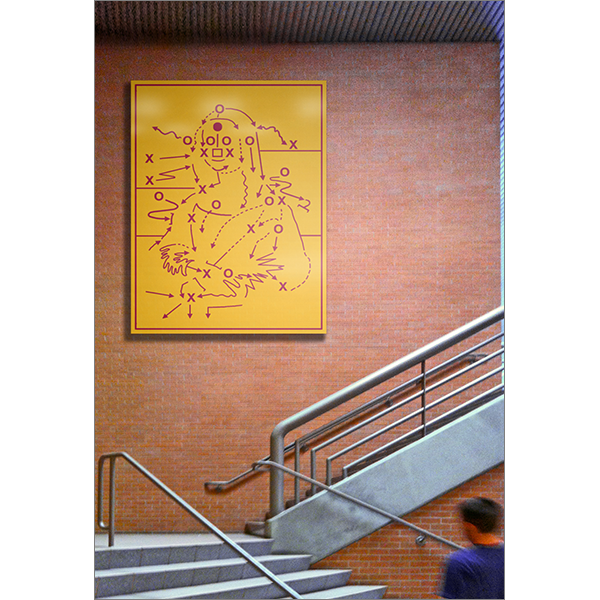
De-Coding the Mona Lisa, Honolulu
Three campus lectures introduce the project's method: University of Hawai‘i, Honolulu (Sep 2, 2004); University of Hawai‘i, Downtown (Sep 8, 2004); and Hawai‘i Pacific University (Nov 4, 2004).
ASU Student Recreation Center, Tempe
Installation documentation records the Mona Lisa work presented at the ASU Student Recreation Center in Tempe, Arizona, situating the project within a student-life and campus-athletics context consistent with its sports-generation premise.
Géométrie Variable, Reims
A Telephonebooth Gallery announcement documents How to explain great art in the age of sports (Mona Lisa) in a 2013 show curated by Baron Osuna. The exhibition is identified in the LG Williams press record as Géométrie Variable at Parc du Domaine les Crayères, Reims, France, May 17–June 30, 2013.
Exhibition announcement ↗︎Laguna Art Museum
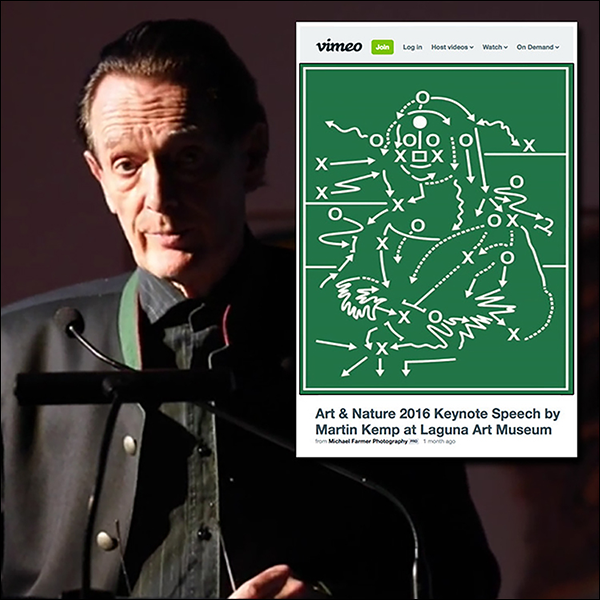
During the same museum period, Leonardo scholar Martin Kemp presented Mona Lisa and the Body of the World. The programs were independent, but together they place Williams's long-running investigation within a broader institutional conversation about Leonardo's portrait.
2004–2025
CONDENSED CHRONOLOGY- 2004
Series begins; three De-Coding the Mona Lisa lectures; Nader/Williams essay published; smile announcement enters the press record.
- 2005
Illustrated analytical document formalizes the down-flat-up model.
- 2013
GrandBag publication; Géométrie Variable exhibition, Reims; Mona Lisa lecture activity.
- 2016–17
Laguna Art Museum programming; FUGA Gallery archive established.
- 2025
AI Cracks the Mona Lisa extends the original investigation.
Full source-level detail for each milestone is preserved in § 12 / Archive.
Primary Sources
SOURCE LEDGER- Mona Lisa — Catalogue Raisonné cover record↗︎
- Picasso / Les Demoiselles d'Avignon — series work, 2004
- Duchamp / The Urinal — series work, 2004↗︎
- Ralph Nader & LG Williams, If Only Art Lovers Were as Diligent as Sports Fans — original illustrated PDF, Nov. 15, 2004↗︎
- If Only Art Lovers Were as Diligent as Sports Fans — Samizdat archival record↗︎
- 2004 De-Coding the Mona Lisa lectures — Honolulu, Downtown, Hawai‘i Pacific University
- LG Williams Discovers "Mystery" Behind Mona Lisa's Smile — 2004 Samizdat record↗︎
- 2005 illustrated analytical document (down-flat-up model)↗︎
- FUGA Gallery archive↗︎
- GrandBag Open Art, May 2013 — French issue↗︎
- Géométrie Variable, Reims — exhibition announcement, 2013↗︎
- Laguna Art Museum — archived program page↗︎
- AI Cracks the Mona Lisa — 2025 Samizdat record↗︎
- Catalogue Raisonné↗︎
- Samizdat↗︎
- Press↗︎
- CV↗︎
How to Cite the Project
CITATION HUBLG Williams / The Estate of LG Williams, How to Explain Art to the Sports Generation, 2004–2025.
LG Williams, “How to Explain Art to the Sports Generation,” project overview and citation hub, 2004–2025, LG Williams / The Estate of LG Williams, https://lgwilliams.com/art-for-the-sports-generation/. Accessed [Month Day, Year].
Citation noteHow to Explain Art to the Sports Generation should be cited as LG Williams's 2004–25 project as a whole, encompassing reflective-sign artworks, graphic variants, lectures, analytical writing, exhibitions, publication covers, archival websites, and later research. Mona Lisa is the project's longest and most developed case study and may be cited separately as such. A foundational primary source is Ralph Nader and LG Williams, Tolerating a No Fault Artistic Accountability: If Only Art Lovers Were as Diligent as Sports Fans, November 15, 2004, which articulates the project's central comparison between sports spectatorship, visual attention, institutional accountability, and art audiences.