BROAD / THE ELI AND EDYTHE BROAD AFFAIR
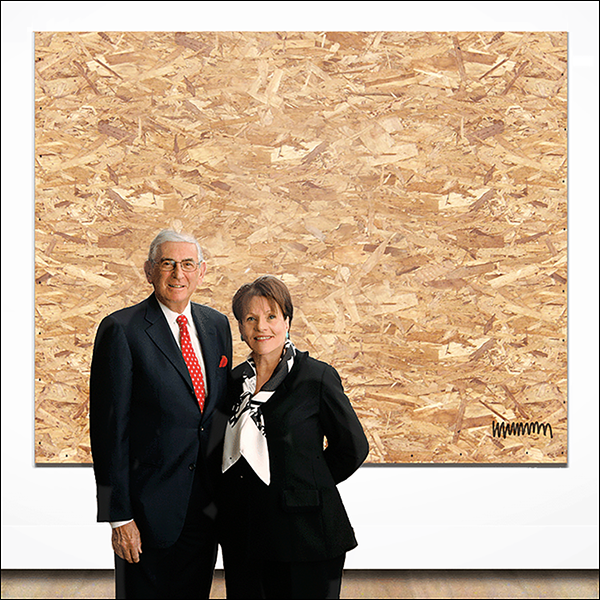
A fictional Broad acquisition turned a rough construction panel into blue-chip art. Through an artist-made photograph, a mock acquisition notice, a rumored price, and the authority of one of America's most powerful collectors, Williams exposed how contemporary-art value can be narrated into existence.
The intervention also brought one of Los Angeles's most powerful cultural institutions into direct contact with a homeless artist who had no institutional support and circulated the project through free digital resources.
The work emerged from the foreclosure landscape surrounding Williams in Scottsdale and Phoenix, where boarded windows, unfinished construction, abandoned properties, and collapsed housing values had made construction board a public sign of economic failure. The Broad fiction converted that damaged-property material into the supposed possession of a housing developer, financier, collector, and museum patron.
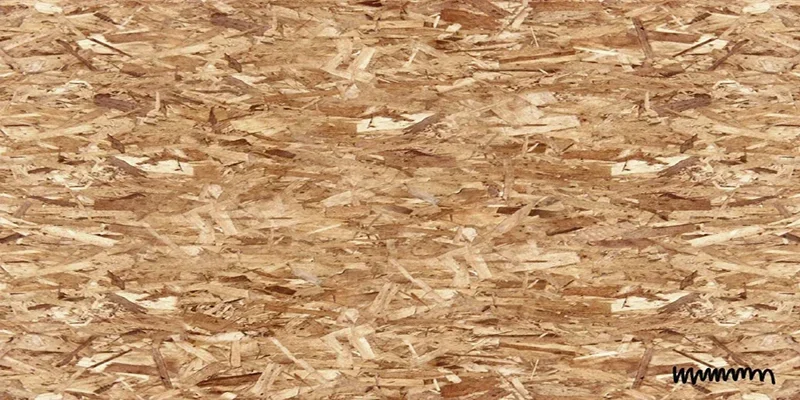
Cracked But OK! #09, 2011
48 × 96″, Chipboard Sheet Screwed To The Wall
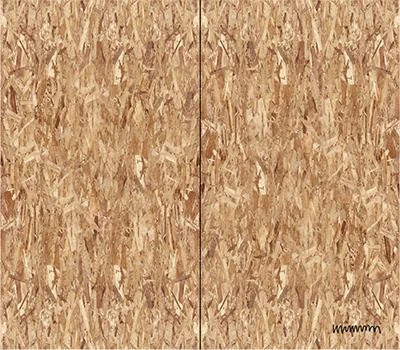
Cracked But OK! #14, 2011
96 × 96″, Chipboard Sheet Screwed To The Wall
THE PURCHASE WAS THE ARTWORK
Broad / The Eli and Edythe Broad Affair did not document a securely established acquisition by Eli and Edythe Broad. It staged one. Williams combined a rough construction-board work with a digitally constructed acquisition image and a mock news release, then supplied the surrounding machinery of blue-chip legitimacy: a billionaire buyer, a purported seller, a rumored price, a financial-news reference, collection statistics, scarcity, future appreciation, and a collector quotation. The project's subject is not simply whether a sale occurred. Its subject is how the appearance of a sale can manufacture value, history, and institutional belief.
The dated artwork, release, publication, Artissima presentation, magazine reproduction, and Catalogue Raisonné establish that the intervention existed and circulated. The surviving record does not establish payment, accession, physical transfer, or ownership by a Broad collection. The distinction is not an embarrassment to be hidden. It is the point at which publicity becomes medium and collecting becomes narrative production.
“I understand plywood.”
The intervention also staged a confrontation between radically unequal forms of cultural power — a test of whether an artist without money, staff, representation, or institutional access could compel one of the city's most powerful cultural organizations to respond. The consequences of that confrontation became part of the artwork itself.
AN ACQUISITION NOTICE BUILT TO PRODUCE BELIEF

The release is written in the language of art-market news. It announces the acquisition, identifies a work number, names a seller, supplies an undisclosed price said to be rumored at $240,069, invokes Bloomberg, describes Broad's collection and strategy, and attributes to him an explanation of why the work matters. Each element performs the function of evidence while remaining part of an artist-made fiction.
- 01Prestigious buyer — The Broad name supplies collector prestige and institutional consequence.
- 02Purported seller — FUCKTHATGALLERY gives the transaction a market intermediary.
- 03Rumored price — $240,069 turns an inexpensive building panel into a quantifiable asset.
- 04Financial-news authority — The Bloomberg reference gives the announcement the appearance of external verification.
- 05Collection statistics — The release places the work inside the scale and logic of a blue-chip collection.
- 06Scarcity — The supposed edition and remaining quantity convert board into controlled supply.
- 07Collector quotation — The attributed statement transforms Broad's homebuilding history into aesthetic expertise.
- 08Photographic proof — The artist-made composite supplies the image readers expect from an acquisition story.
- 09Press contact — "May Bell McBabe" completes the institutional performance.
- 10Archive repetition — Later reproduction, cataloguing, and website circulation demonstrate how the fiction can harden into documentary appearance.
THE CONSTRUCTION-BOARD WORKS
Cracked But OK! was not a single conventional painting. The surviving archive records a numbered body of rough board works presented through Super Window Project and Artissima 18. Their surfaces resemble the engineered sheet material used in construction, enclosure, repair, and the securing of damaged or vacant property. The Catalogue Raisonné describes the recorded works as plywood mounted on the wall; the original release calls the alleged acquisition a 4 × 8-foot chipboard panel screwed to the wall; the artist book repeatedly uses a surface visually resembling oriented strand board.
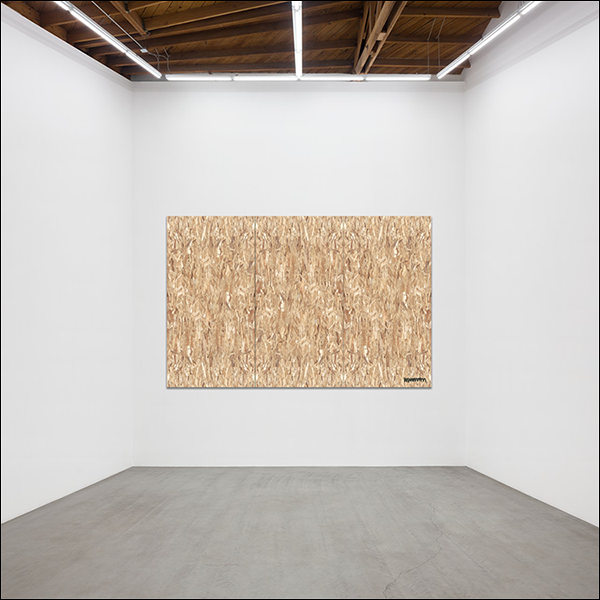
2011 · Dimensions variable
Plywood mounted on wall · Edition of 5
Cat. LGW-2011-09-03
Catalogue Raisonné record
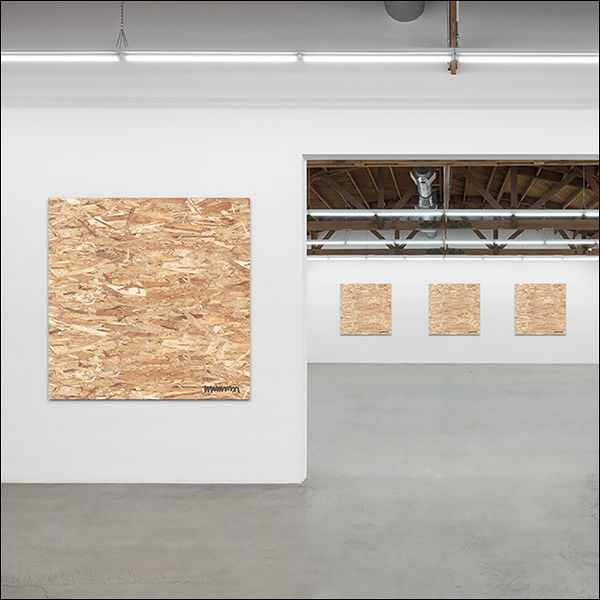
2011 · Dimensions variable
Plywood mounted on wall · Edition of 5
Cat. LGW-2011-09-04
Catalogue Raisonné record
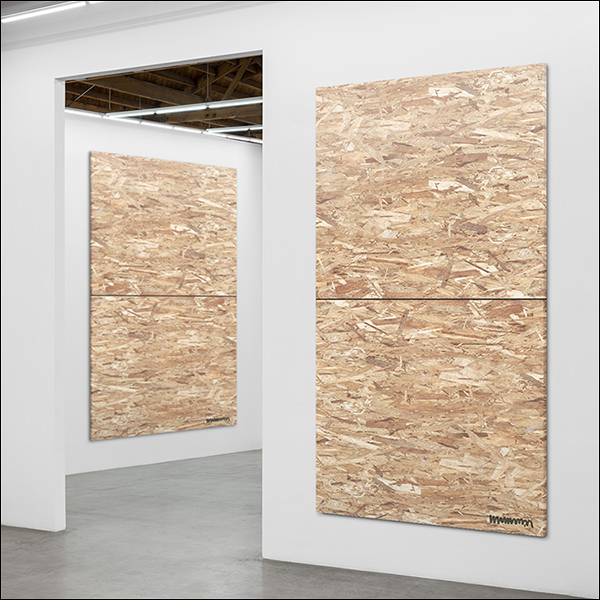
2011 · Dimensions variable
Plywood mounted on wall · Edition of 5
Cat. LGW-2011-09-5
Catalogue Raisonné record
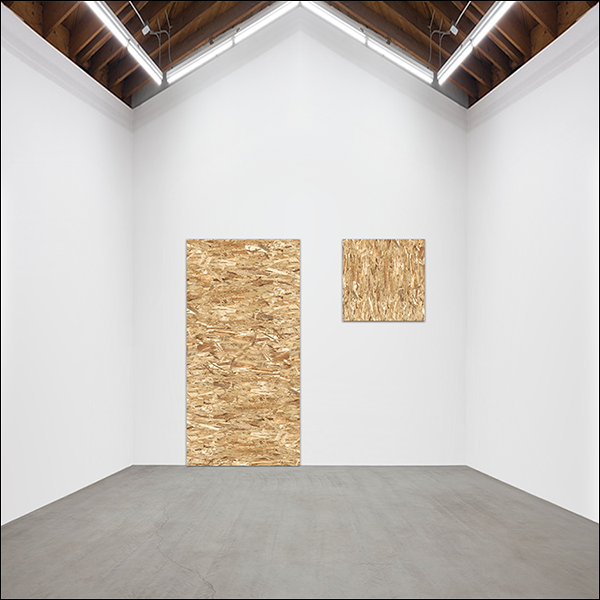
2011 · Dimensions variable
Plywood mounted on wall · Edition of 5
Cat. LGW-2011-09-10
Catalogue Raisonné record
CRACKED BUT OK! IN PUBLICATION
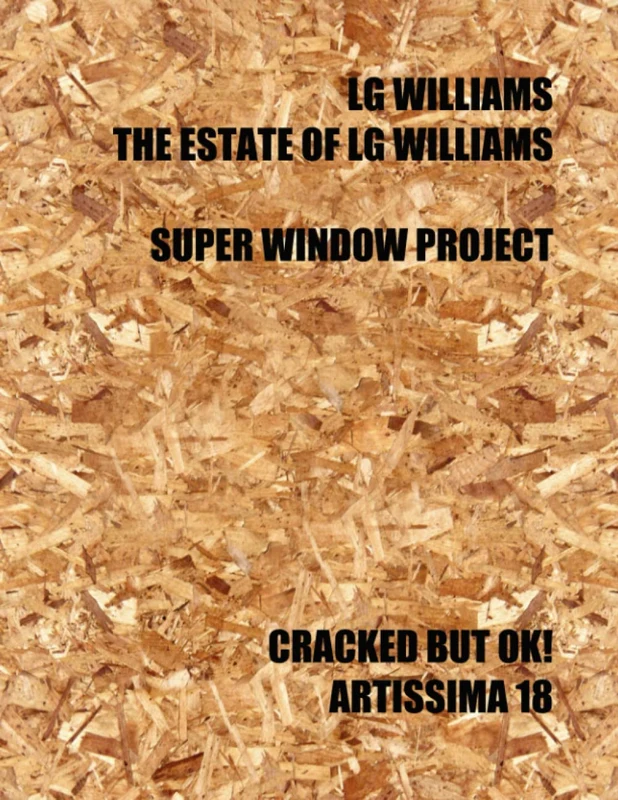
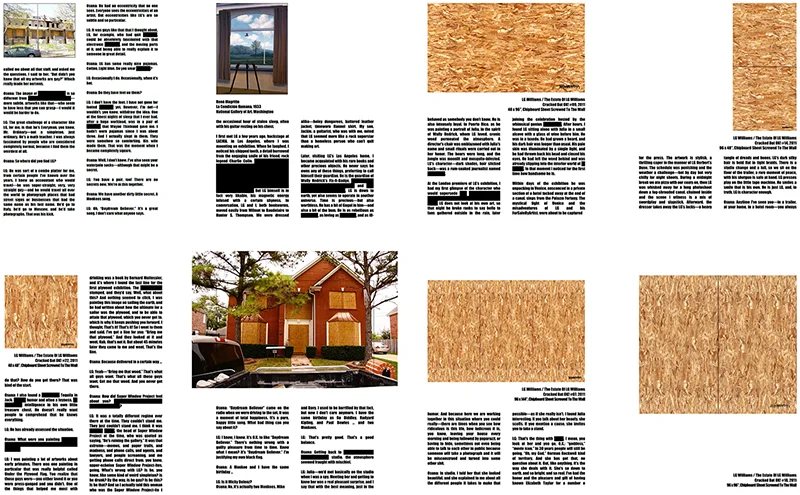
The 37-page artist book extends the installation into publication. Its cover and repeated opening pages use an OSB-like strand-board texture; its colophon identifies LG Williams / The Estate of LG Williams, Super Window Project, Artissima 18, Turin, and the November 4–6, 2011 presentation. The magazine-style profile "The Cracked Mind of LG Williams," attributed to Baron Osuna, should be presented as part of the project's persona and publication apparatus—not as neutral reporting detached from the work.
LA STAMPA HIGHLIGHTS WILLIAMS'S IMPERTINENCE
Rocco Moliterni, writing in Turin's major daily newspaper La Stampa, singled out Williams's presentation at Artissima 18 as the fair's disruptive exception. Published during the fair itself, the notice is contemporary third-party evidence that Williams's practice registered not simply as another art-fair display, but as an intervention whose antagonistic tone distinguished it from its surroundings. Moliterni's example is another Williams work presented through Super Window Project at the fair, Better than Picasso; the notice's documentary value for the Broad affair is its dated, independent attestation of Williams's presence at Artissima 18 and of the “impertinence” of the practice at the exact moment the acquisition fiction was circulating.

Moliterni described the fair as "sleepy," but wrote that it could awaken through the kind of "impertinence" represented by LG Williams and Super Window Project.
Quotation translated from the Italian; original wording is reproduced in the source facsimile.
THE EXACT TARGET
Eli Broad was not interchangeable with a generic rich collector. The work selected a public figure whose biography joined the systems the project sought to compress: mass housing, real-estate development, financial services, strategic contemporary-art collecting, museum governance, civic philanthropy, and the conversion of private wealth into public cultural authority.
The selection was also nominal and material. The collector's name is a near-homophone of the builder's board: Broad / board. During the subprime collapse, boards were appearing on windows and doors across the country — nowhere more visibly than in the Phoenix metropolitan area, where Williams, a Los Angeles artist, was then temporarily living. Boards everywhere, an artist among them, and a billionaire named Broad whose fortune began in housing: the pun closed the circuit between material, place, and target. The project also carried a candid economic genesis. Williams needed a sale, and he wanted Broad — the collector best matched to the material — to buy the work. The fiction staged the acquisition the market withheld, performing the transaction as art.
Do not casually call a 2011 contact "a Broad museum representative" unless correspondence proves that exact affiliation. Depending upon the recovered source, accurate wording may be Broad Art Foundation representative, representative of the Broad collection, representative of the planned Grand Avenue museum, or BCAM / LACMA representative.

An Unrealized Collaboration With Paul McCarthy and LG Williams: Two Enormous Inflatable Rolls of Toilet Paper (Black and White)
2008 · 20 feet high · Two giant inflatables · Proposed site: Broad Contemporary Art Museum, Los Angeles
The Broad institutional field had already entered Williams's work before the 2011 acquisition fiction. This unrealized 2008 proposal identified BCAM at LACMA as its proposed site.
THE FICTION PRODUCED A REAL INSTITUTIONAL RESPONSE — AND A CURATORIAL STRATEGY
On October 24–25, 2011, the Broad acquisition fiction entered a new phase. The Broad Foundation left Williams a telephone message twelve days after the mock announcement circulated. In the correspondence that followed, Williams told Baron Osuna, director of Super Window Project, Kyoto, that a strategy had been developed, that the participants intended to “hold the line,” and that they wanted to “make sure we negotiate with a curator.” Osuna immediately raised the possibility of litigation over the use of Broad's image; Williams answered that no court case would follow. The thread documents a coordinated effort to bring the fictional acquisition before real curatorial authority.
The distinction is fundamental. Williams was not merely seeking a response from the Foundation's administrative machinery. He was insisting that the intervention be encountered as an artwork and addressed by someone empowered to make curatorial judgments. The fiction had therefore accomplished something more consequential than attracting attention: it had converted an invented acquisition into a real institutional encounter organized around who possessed the authority to determine whether the intervention belonged within art.
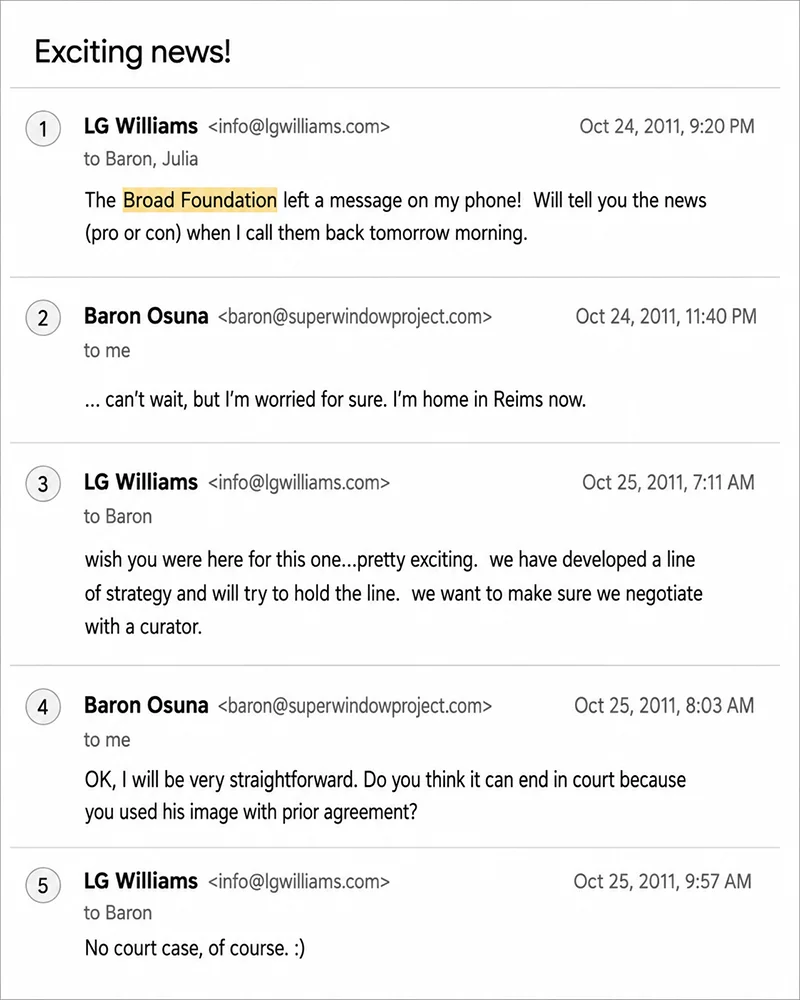
Subject: Exciting news!
- October 24, 2011, 9:20 PM — LG Williams <xxxxxxxxx@lgwilliams.com> to Baron, Julia
“The Broad Foundation left a message on my phone! Will tell you the news (pro or con) when I call them back tomorrow morning.” - October 24, 2011, 11:40 PM — Baron Osuna <xxxxxxxxx@superwindowproject.com> to Williams
“… can't wait, but I'm worried for sure. I'm home in Reims now.” - October 25, 2011, 7:11 AM — LG Williams <xxxxxxxxx@lgwilliams.com> to Baron
“wish you were here for this one…pretty exciting. we have developed a line of strategy and will try to hold the line. we want to make sure we negotiate with a curator.” - October 25, 2011, 8:03 AM — Baron Osuna <xxxxxxxxx@superwindowproject.com> to Williams
“OK, I will be very straightforward. Do you think it can end in court because you used his image with prior agreement?” - October 25, 2011, 9:57 AM — LG Williams <xxxxxxxxx@lgwilliams.com> to Baron
“No court case, of course. :)”
View complete original email captures →
Osuna's phrase “with prior agreement” — written from Reims by a French speaker — appears in context to intend “without prior agreement.” The wording is preserved as written.
The thread's evidentiary value lies as much in its texture as in its content. Williams promises the news “pro or con” — he does not yet know the outcome. Osuna, writing near midnight from Reims, is worried. The strategy is settled overnight and reported at 7:11 the next morning; the legal question is raised at 8:03 and dismissed by 9:57. This is the contemporaneous record of an intervention still unfolding, written by participants who could not know how it would end — the opposite of a story assembled in hindsight.
Dr. Julia Friedman was among the first recipients of the news, and the collective language of the correspondence — “we have developed a line of strategy” — is consistent with her active involvement. According to Williams, Friedman, acting as an art historian, subsequently spoke with a Broad curator on his behalf, serving as the informed intermediary between the artist and the institution whose collecting authority the intervention had appropriated.
Documentary note: the October 24–25, 2011 correspondence records the Broad Foundation's contact, the participants' curatorial strategy, concern about possible litigation, and the effort to secure a curator-level response. The later published account preserves Williams's wording of the institution's eventual position. These sources are related but should not be presented as though the 2011 thread itself were a verbatim transcript of the curator's statement.
The affair began by asking whether Broad's name could turn construction board into blue-chip art. The recovered correspondence shows that the fiction then generated a real institutional response, a deliberate curatorial strategy, and an immediate, documented concern about legal consequences. According to Williams's later published account, it ended with the disclosure that the institution did not care whether the object was art. The institution's refusal to adjudicate the question did not remain outside the artwork. It became the artwork's final institutional act.
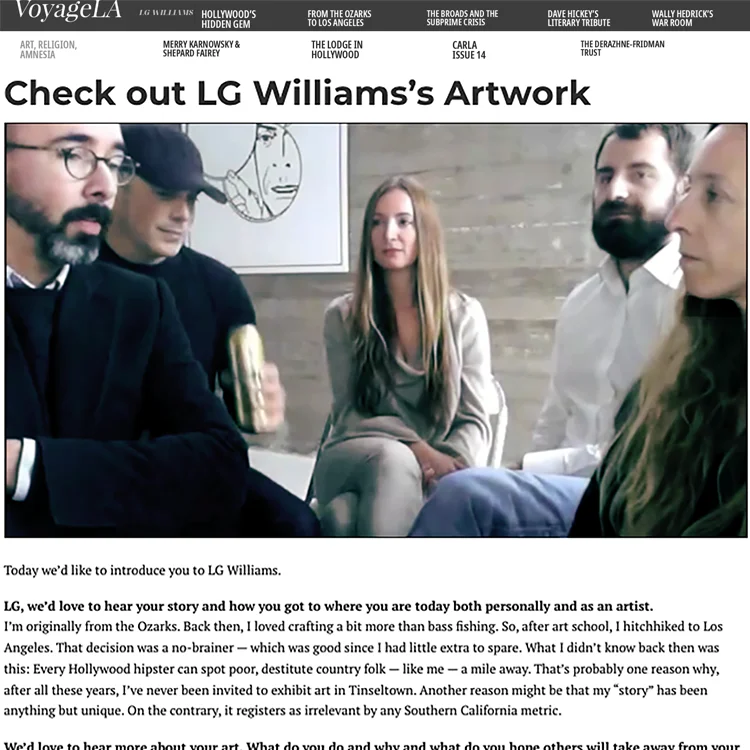
Williams later supplied his account of the exchange in the 2019 VoyageLA interview “Check Out LG Williams's Artwork.” Recounting the Broad affair, he stated that a Broad representative finally told him:
“They don't care even if it is art.”
LG Williams, quoted in “Check Out LG Williams's Artwork,” VoyageLA, June 5, 2019. Later published first-person account of the Broad Foundation exchange.
This sentence is Williams's later published account of the representative's response. It is not presented as a surviving 2011 transcript. Read the interview
The remark is the affair's decisive reversal. Williams had constructed an elaborate machinery of artistic legitimacy: the collector's name, the acquisition photograph, the price, the seller, the press language, the edition, the publication, and the international art-fair context. The reported institutional response declined the underlying question altogether.
The Broad Foundation did not, in Williams's account, settle whether the panel was art. It disclosed that the institution did not need to settle the question. Its power included the ability not to care.
The affair therefore ends neither with authentication nor refutation. It ends with institutional indifference — the privilege of an organization so powerful that the artistic status of the object could be treated as immaterial.
- Broad Foundation telephone message documented.
- Date and recipients documented.
- Curatorial strategy and intention to "hold the line" documented.
- Litigation concern raised and dismissed in real time.
- Content of the underlying voicemail and phone call not preserved.
- Williams recounts the exchange in 2019.
- He attributes the sentence to a Broad representative.
- The sentence is a later published recollection, not a surviving transcript.
- The account supplies the project's reported conclusion.
INSTITUTIONAL POWER AND MARGINAL ARTISTIC AGENCY
The confrontation was radically unequal. Eli Broad stood at the center of Los Angeles cultural power: developer, financier, collector, philanthropist, museum patron, and civic institution-builder. His name carried wealth, staff, foundations, professional communications, legal resources, museum relationships, real estate, and enormous influence over what the city preserved and recognized as culture.
Williams occupied the opposite position. He was marginalized, homeless, excluded from the institutions that confer artistic visibility, and operating with no institutional support whatsoever.
The imbalance was not merely reputational. It was infrastructural. Broad commanded the cultural machinery of Los Angeles. Williams had no gallery staff, museum office, communications department, legal team, foundation, or institutional platform. He constructed and circulated the intervention through free Gmail, free digital resources, and free Starbucks Wi-Fi. In those terms, the encounter was almost absurd: a bulldozer against an ant. And Williams did not merely seek acknowledgement: the recovered correspondence shows him resolving to hold the line and to force the encounter onto artistic ground — “we want to make sure we negotiate with a curator.”
- Billionaire wealth
- The Broad Foundation
- Museum and collection staff
- Real-estate and financial power
- Professional communications
- Legal resources
- Museum relationships
- Civic authority
- The ability to shape Los Angeles cultural history
- A construction-board artwork
- A laptop
- Free Gmail
- Free digital tools
- Free Starbucks Wi-Fi
- No museum
- No foundation
- No professional staff
- No legal or communications apparatus
- No institutional support whatsoever
Yet the ant entered the machine. With almost no material resources and no institutional backing, Williams produced a construction-board artwork, an acquisition image, a press release, and a narrative credible enough to reach the Broad Foundation itself.
The artist who had been denied access to the cultural institution made the institution enter the artwork's field. Broad could disregard Williams. He could not prevent Williams from making Broad part of the artwork.
This is the affair's central paradox. The institution possessed the power to confer value, purchase visibility, build museums, organize publicity, and ignore an artist without consequence. Williams possessed the artistic power to manufacture a situation the institution had to answer.
The Broad Affair is therefore not simply a satire of collecting or a prank about the price of plywood. It is a confrontation between two radically unequal powers: the institutional power to authorize culture and the artistic power to create a fact that the institution must confront. The work does not defeat the institution. It demonstrates that exclusion does not eliminate artistic agency.
FROM BUILDING PANEL TO BLUE-CHIP TROPHY
The work does not ask the viewer to believe that plywood is intrinsically valuable. It demonstrates how value is attached. A cheap, rough, damaged-looking sheet enters a sequence of documentary and institutional operations until it appears as a scarce, appreciating work worthy of a billionaire collection.
A standardized building sheet associated with construction, repair, vacancy, and enclosure.
The panel is titled, numbered, and positioned within a series.
Super Window Project and Artissima provide international circulation.
The Broad name attaches wealth, strategy, and cultural authority.
The rumored figure converts perception into market measurement.
The release borrows the form of externally reported fact.
The composite creates apparent visual proof.
The artist book turns a temporary presentation into a durable bibliographic object.
Samizdat, the Catalogue Raisonné, magazine reproduction, and this page preserve the work's continuing documentary life.
“The physical board begins as inexpensive building material. The release adds a prestigious buyer, an alleged seller, a rumored price, a financial-news source, collection history, scarcity, future appreciation, a collector quotation, and photographic 'proof.'”
THE REGIONAL BACKGROUND OF THE PLYWOOD WORKS
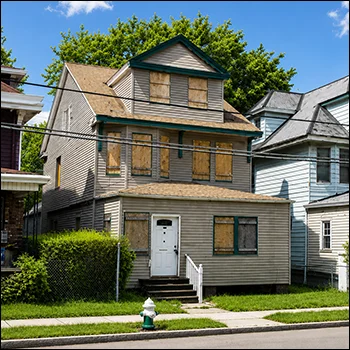
At the time of Cracked But OK! and the Broad affair, Williams was living in the Scottsdale–Phoenix area and teaching art history at Arizona State University in Tempe. The plywood works emerged within a metropolitan landscape marked by the aftermath of the housing crash: foreclosed homes, abandoned construction, vacant developments, and boarded openings.
Between 2007 and 2011 the Phoenix metropolitan area recorded some of the steepest home-price declines and foreclosure rates in the country. Subdivisions were left unfinished, existing houses stood vacant and boarded, and construction sheathing became a common sight across the region — the material and visual environment from which Cracked But OK! drew its rough board surface. See § 12 / Related Works and § 13 / Publications & Interviews for the fuller foreclosure-era sequence and its documentary sources.
Foreclosed homes, unfinished subdivisions, vacant properties, boarded openings, construction sheathing, mortgage delinquency, and collapsing prices formed the background from which Cracked But OK! emerged. The project does not simply illustrate the subprime mortgage crisis. It carries the material atmosphere of a region where the house had become both damaged architecture and failed financial instrument.
The board surface should therefore be read historically and geographically. Plywood, chipboard, and OSB belong to construction, but during the crisis they also became signs of suspension: a house unfinished, a window sealed, a property repossessed, a development abandoned, or an opening closed against weather and trespass. The work takes that low, provisional material and imagines it moving into the possession of a billionaire whose fortune began in housing.
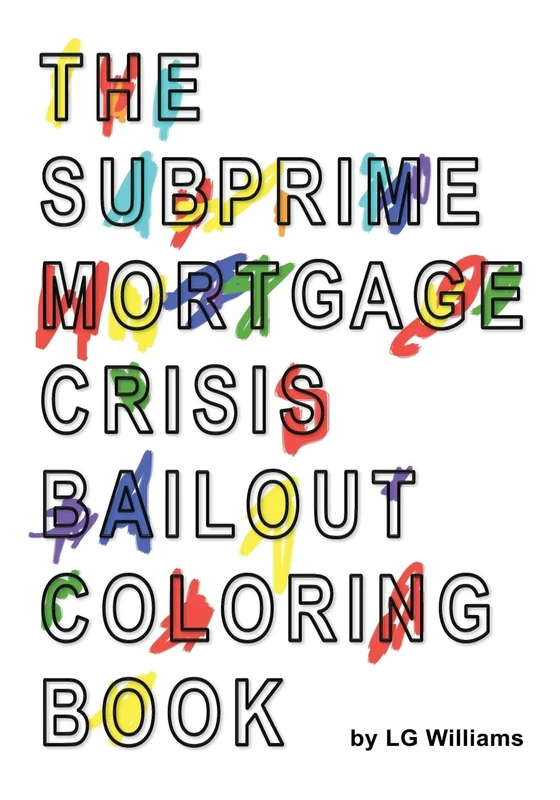
THE SUBPRIME MORTGAGE CRISIS BAILOUT COLORING BOOK · 2013
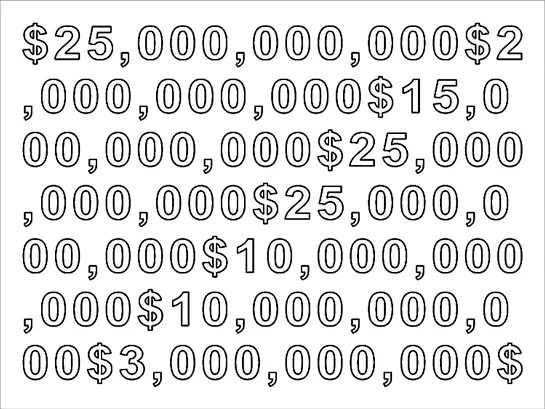
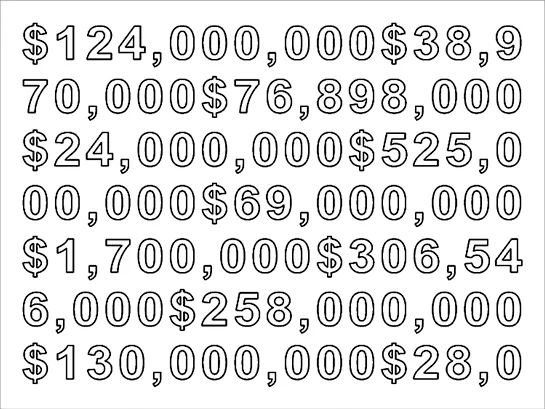
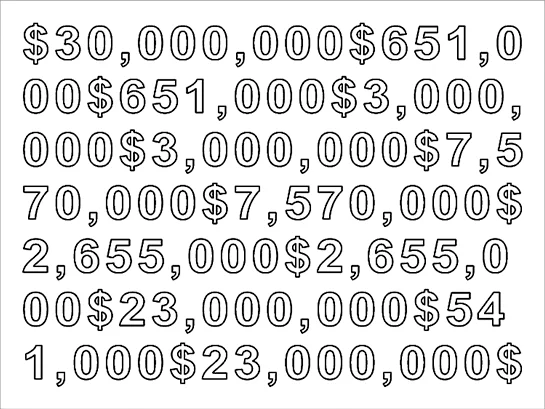
The coloring book translates subprime lending, securitization, adjustable-rate resets, delinquency, foreclosure, institutional collapse, federal intervention, and bailout totals into an educational workbook form. Vast sums become outlined figures waiting to be filled in. PCP Press record. The surviving record includes a 2013 original date and a later revised interior; the CV lists 207 pages, the surviving 2025 PDF contains 231 pages, and the current PCP catalogue records 233 pages — preserved as edition / version differences.
Toward a Necrosemiotic Archaeology of the Subprime Catastrophe (The Subprime Quantitative Easing Portfolio)
The portfolio's complete titles name FICO-indexed subjectivity, mortgage-backed securitization, toxic tranches, "too big to fail," taxpayer-funded redemption, eviction, and foreclosure. The bureaucratic and theoretical excess mirrors the financial machinery that converted individual mortgages into opaque market instruments.
BANKRUPTCY, HOUSING, DEBT & FORECLOSURE
Broad / The Eli and Edythe Broad Affair belongs to a longer body of work in which Williams treated financial failure, damaged housing, debt, delinquency, foreclosure, bailout, homelessness, and institutional value as connected forms. The Broad fiction is the point at which this field meets the billionaire collector and museum patron.
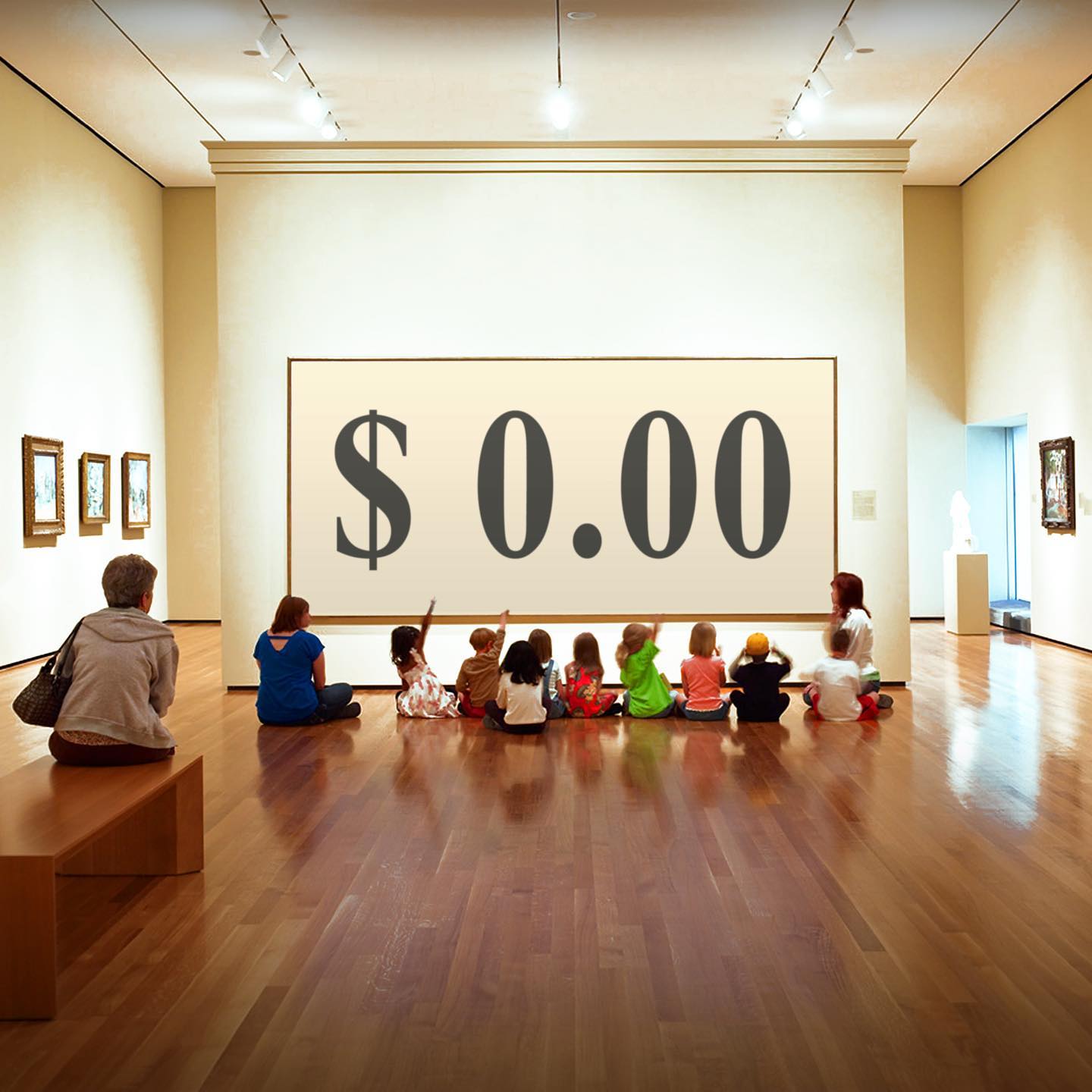
Establishes financial failure as a subject before the housing crash. The current homepage / later records may use 2004 for a major Bankrupt work; date variants are preserved until object-level records are reconciled.

A site-specific sculpture by LG Williams on Maui — a plantation-style house with its entire floor removed, transforming the collapse of economic, personal, environmental, and existential foundations into a full-scale architectural condition.
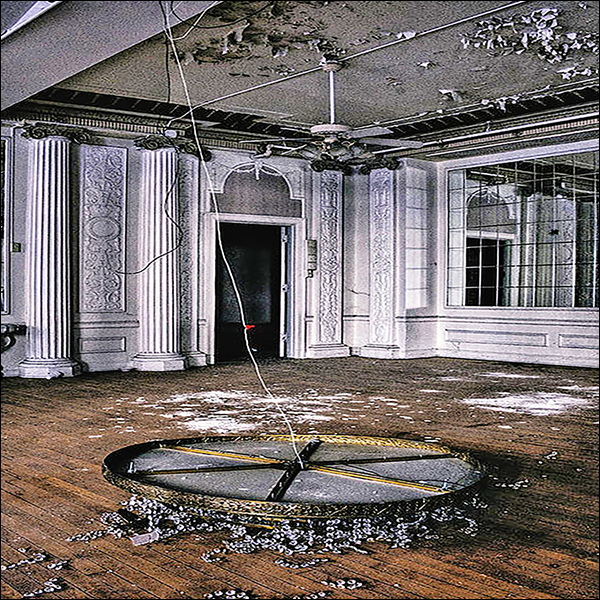
The Catalogue Raisonné places this installation within the foreclosed Dingfield-Tysons antebellum home in Washington, Georgia (LGW-2013-72-01-02), extending the foreclosure subject from Arizona into another historical property.

The 2019 monograph retrospectively connects bankruptcy, homelessness, financial failure, and the interpretation of Williams's art. Its chapter structure — including Approaching the Bankrupt, Achieving Bankruptcy, Expanding the Bankrupt, and Extravagant Bankruptcy — confirms that insolvency is a sustained conceptual framework rather than a one-off theme. PCP Press record
HOW THE PROJECT EXPLAINED ITSELF
VoyageLA, “Check Out LG Williams's Artwork,” June 5, 2019. Williams's later first-person account supplies the reported conclusion of the Broad Foundation exchange: “They don't care even if it is art.” The interview should be read together with the October 24, 2011 email, which documents the Foundation's initial contact but not the content of the subsequent call.
Documentary function: later published recollection of the exchange's outcome.
VoyageLA interview
Establishes the Estate as an artistic apparatus; the relationship between marginalization and self-produced institutional authority; the simultaneous critique and use of publicity, sales, and media attention; For Sale By Artist and the United States debt crisis; and the later magazine reproduction of the Broad composite identifying the alleged work as #09.
GrandBag interview (PDF)
The Java Magazine profile provides the strongest published connection between Williams's damaged-house work and the housing crisis. It identifies bad mortgages, foreclosure, an abandoned house, and the continuing hurt of the collapse as the context for House Where the Bottom Fell Out.
Java Magazine (PDF)Williams's October 24, 2011 email to Baron Osuna and Dr. Julia Friedman documents the Broad Foundation's initial contact. Williams's later published account in VoyageLA supplies the reported conclusion. See § 07 / The Real Institution Responds.
SOURCES, MATERIAL VARIANTS & SURVIVING EVIDENCE
Broad / The Eli and Edythe Broad Affair survives through several interconnected forms of evidence: the original mock release, the artist-made composite, the Cracked But OK! board works, the Artissima presentation and artist book, contemporary magazine reproduction, the current Samizdat description, the Catalogue Raisonné, and later Estate documentation. This section identifies what each source establishes and preserves material or bibliographic variants where they affect the reader's understanding of the work.
- 1. The acquisition fiction — The original release performs the purchase as news. The current Samizdat record makes the mechanism explicit by describing the acquisition as imagined and the notice as parody.
- 2. The image — The Catalogue Raisonné identifies the Broad image as an artist-made Photoshop composite. It is an artwork and documentary device, not neutral photographic proof.
- 3. The international presentation — The Artissima artist book establishes Super Window Project, Artissima 18, Turin, and November 4–6, 2011.
- 4. The physical series — The Catalogue Raisonné records multiple Cracked But OK! works as plywood mounted on the wall, dimensions variable, edition of five.
- Variants & Attribution
- 5. Work number — The original 2011 release and 2013 GrandBag caption identify #09. The current Catalogue Raisonné composite identifies #17. Both are preserved until the image history is reconciled.
- 6. Material — The release uses chipboard. The Catalogue Raisonné uses plywood. The publication surface visually resembles OSB. Source terminology is stated rather than collapsed into one material.
- 7. Quantity / edition — The release describes one of thirty-five, with thirty-one remaining. The Catalogue Raisonné records individual works as editions of five. These may describe different structures; the relationship is not yet established.
- 8. Publication date — The documented project and current PCP record date Cracked But OK! to 2011. The surviving revised colophon states "First PCP Press edition 2009." The contradiction is preserved until the edition history is clarified.
- 9. Institutional identity — The Grand Avenue Broad museum opened in 2015. Any 2011 representative must be identified through the period-correct institution documented in the source.
- 10. Ownership — The archive establishes the artwork and fictional acquisition apparatus. It does not presently establish payment, accession, physical transfer, or ownership by a Broad collection.
- 11. Institutional response — The October 24, 2011 email documents that the Broad Foundation contacted Williams. The 2019 VoyageLA interview preserves Williams's later published account of the exchange's conclusion. The page distinguishes the contemporaneous record from the later recollection.
- 12. Power asymmetry — The page's interpretation of the affair as a confrontation between institutional authority and marginal artistic agency is supported by the documented Broad institutional field, Williams's homelessness and lack of institutional support, the free digital means used to circulate the intervention, the Foundation's direct contact, and Williams's later published account.
PLYWOOD AS SIGN, SUPPORT & PUBLIC ADDRESS
The Catalogue Raisonné's remaining exact plywood records are 2014 signage works installed on Camden Drive in Beverly Hills. They show the rough board continuing after the Broad affair as a public-facing support for language, availability, publicity, and self-construction.
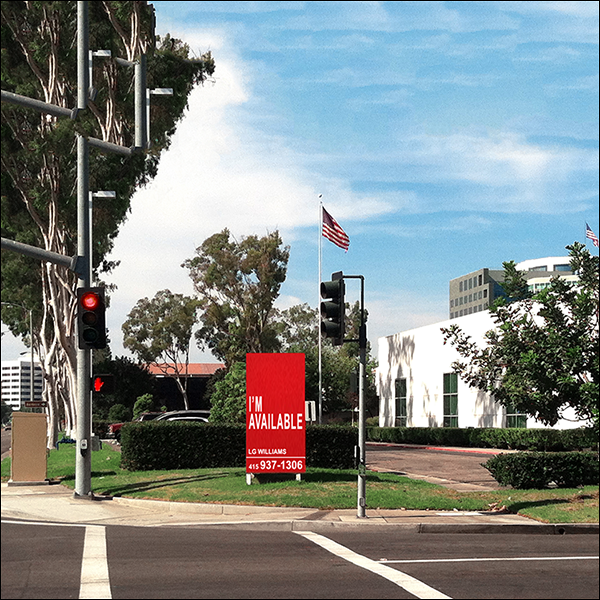


In Cracked But OK!, construction board becomes a fictional trophy. In the 2014 works, plywood becomes signage: a support for public availability, commentary, publicity, and biographical fiction. The material moves from foreclosure-era surface to urban address while retaining its provisional, commercial, and declarative character.
FROM BANKRUPTCY TO THE BROAD AFFAIR
Bankrupt works transform zeroed financial figures into monumental reflective signs.
Later records identify a major Bankrupt work with this date; reconciled with earlier Catalogue Raisonné records.
House Where the Bottom Fell Out develops through a damaged and abandoned domestic structure.
The housing crisis becomes nationally visible through delinquency, foreclosure, vacancy, failed developments, and falling values.
Unrealized Paul McCarthy / LG Williams proposal names the Broad Contemporary Art Museum as proposed site.
For Sale By Artist connects art, state property, and the United States debt crisis.
Mock Broad acquisition notice is issued.
Williams emails Baron Osuna and Dr. Julia Friedman to report that the Broad Foundation has left a telephone message. He plans to return the call the following morning and relay the outcome "pro or con."
Cracked But OK! appears through Super Window Project at Artissima 18, Turin.
Twentynine Palms Installation names delinquencies in the Southern California high desert.
GrandBag interview reproduces the Broad composite and identifies the alleged work as #09.
Java Magazine connects House Where the Bottom Fell Out to bad mortgages, foreclosure, and the housing collapse.
The SubPrime Mortgage Crisis Bailout Coloring Book is first published.
Subprime Quantitative Easing Portfolio names securitization, toxic tranches, bailout, eviction, and foreclosure.
Catalogue records installation in the foreclosed Dingfield-Tysons home.
Plywood signage works appear on Camden Drive, Beverly Hills.
The Broad opens on Grand Avenue in Los Angeles, giving permanent institutional form to the collection and museum project that was still under development when the 2011 intervention circulated.
History, Homelessness, and Bankruptcy retrospectively consolidates the financial-failure field.
In a VoyageLA interview, Williams publishes his account of the exchange's conclusion, attributing to a Broad representative the statement: "They don't care even if it is art."
Eli Broad dies in Los Angeles. The Broad Affair remains in the archive as a record of Williams's 2011 intervention into the collector's cultural and institutional authority.
Revised Cracked But OK! artist book retains a colophon stating "First PCP Press edition 2009."
Revised SubPrime book interior produces a later edition / page-count record.
Current Samizdat description explicitly identifies the Broad acquisition as imagined parody; this landmark page consolidates the surviving evidence.
WHO HAS THE POWER NOT TO CARE?
The Broad Affair remains relevant because cultural authority is not distributed equally. Museums, foundations, collectors, donors, and communications systems possess the resources to turn statements, images, acquisitions, and affiliations into historical fact. Artists outside those systems are often expected to disappear without leaving a record.
Williams's intervention reverses that expectation. Using resources available at virtually no cost, an artist with no institutional support created a work that crossed the boundary between exclusion and authority. The Broad Foundation's reported indifference does not erase that achievement. It clarifies the unequal terms of the confrontation, while the Foundation's response remains preserved as part of the artwork's documentary record.
“They don't care even if it is art” is devastating because indifference is itself a form of institutional power. The institution did not need to authenticate the work, disprove the fiction, or resolve the artistic question. It could remain above the dispute.
The affair remains relevant because cultural value is still produced through announcements, images, institutional association, market language, and repetition across digital archives. What Williams staged manually in 2011 — the appearance of acquisition as a generator of value — now resembles the ordinary circulation of contemporary-art legitimacy online. The surviving record also preserves something institutions generally control themselves: the terms of their own appearance in cultural history. Here, the artist's archive, rather than the institution's publicity apparatus, determines how the encounter remains visible.
The Broad Affair began by asking whether a billionaire's name could turn construction board into blue-chip art. According to Williams, it ended when the billionaire's institution disclosed that it did not care whether it was art at all. Between those two moments, a homeless artist with no institutional support made one of Los Angeles's most powerful cultural organizations enter the artwork and answer it.
PRIMARY DOCUMENT ARCHIVE
- 01 Original mock acquisition PDF — Oct 12, 2011 · open
- 02 Current Samizdat archival interpretation · open
- 03 Broad composite — Catalogue Raisonné image · open
- 04 Cracked But OK! — PCP Press record · open
- 05 Cracked But OK! #3 image · open
- 06 Cracked But OK! #4–8 image · open
- 07 Cracked But OK! #5 & #6 image · open
- 08 Cracked But OK! #16 image · open
- 08a La Stampa — Rocco Moliterni, Nov 4, 2011 · PDF · archived
- 09 GrandBag English interview · open
- 10 Java Magazine — Unconventional Wisdom · open
- 11 SubPrime Mortgage Crisis Bailout Coloring Book — PCP Press · open
- 12 History, Homelessness, and Bankruptcy — PCP Press · open
- 13 The Broad — official institutional history · open
- 14 The Broad collection overview PDF · open
- 15 Federal Reserve History — Subprime Mortgage Crisis · open
- 16 Financial Crisis Inquiry Report · open
- 17 HUD — Revitalizing Foreclosed Properties with Land Banks · open
- 19 Earlier BCAM proposal image — LGW-2008-03-02 · open
- 20 Bankrupt — LGW-1999-18-01 · open
- 21 Bankrupt — LGW-1999-18-01b · open
- 22 Bankrupt — LGW-1999-18-02b · open
- 23 Bankrupt — LGW-1999-18-03b · open
- 24 Subprime QE Portfolio — LGW-2013-74-01 · open
- 25 Subprime QE Portfolio — LGW-2013-74-02 · open
- 26 Subprime QE Portfolio — LGW-2013-74-03 · open
- 27 Foreclosed Dingfield-Tysons installation — LGW-2013-72-01-02 · open
- 28–31 2014 plywood signage records · 01 · 01-01 · 02 · 02-01
- 32 LG Williams email to Baron Osuna and Dr. Julia Friedman regarding Broad Foundation contact, October 24, 2011 — archival email image documenting the initial telephone message and Williams's intention to return the call. open
- 33 VoyageLA, “Check Out LG Williams's Artwork,” June 5, 2019 — Williams's later published account of the Broad Foundation exchange and the reported statement, “They don't care even if it is art.” archived interview