Wally Hedrick / LG Williams
War Room at
2003 San Francisco
Int'l Art Fair
At San Francisco International Art Fair 5, Chronicle critic Kenneth Baker called Wally Hedrick's War Room "a significant item of Bay Area art history."
Recovery, curation, and the return of a Bay Area antiwar environment
1999–2003 · Afterlives 2006–2026
Wally Hedrick, artist. LG Williams — curator.
Fort Mason Center · San Francisco
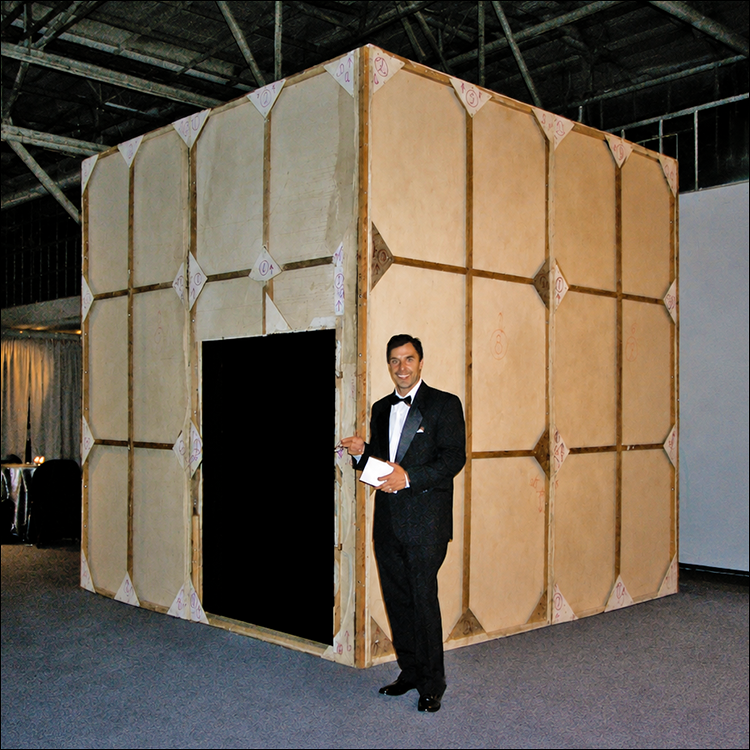
The Room Inside the Fair
2003 · LANDMARK EVENTIn 2002–03, LG Williams helped return Wally Hedrick's War Room to public view after roughly three decades of storage and limited visibility, culminating in an installation Kenneth Baker described as unique in the fair's history, at San Francisco International Art Fair 5, where Hedrick's Vietnam-era architecture of blackness and refusal confronted the commercial art-fair system during the public buildup to the United States–led invasion of Iraq, approximately two months before hostilities began on March 20, 2003.
LG Williams helped recover and re-present Wally Hedrick's War Room at San Francisco International Art Fair 5 in 2003, placing a historic antiwar environment inside the machinery of the art market.
The fair opened sixty-one days before the invasion of Iraq, placing Hedrick's Vietnam-era antiwar environment within the final public buildup to another American war — see § 06.
This page's subject is not a general biography of Wally Hedrick, nor a scrapbook of his association with Williams. It is a specific curatorial operation: the recovery, reconstruction, documentation, publication, and re-presentation of an antiwar environmental painting whose black surfaces face inward and whose stretcher backs face the public world — installed inside a system built for outward display, circulation, and sale.
Kenneth Baker's contemporary San Francisco Chronicle review supplies the outside witness: writing in real time, he called the installation "a significant item of Bay Area art history." That verified phrase, not a larger paraphrase, is this page's documentary anchor — argued, not asserted.
What War Room Is
OBJECT RECORDWally Hedrick, War Room, 1967–68/2002. Oil on canvas; environmental painting / freestanding enclosure. Eight principal canvases, approximately 5 × 11 feet each, bolted into a cubic room; one incorporates a hinged entry panel. Collection of Paul and Karen McCarthy.
The black painted surfaces face inward. The stretcher backs face outward. This reversal is fundamental: it turns the conventional public face of painting away from the public and makes the painted field an interior condition entered by the viewer, not observed from a fixed exterior position.
War Room is simultaneously a painting, a room, a freestanding sculptural enclosure, an environmental artwork, a political architecture, and a structure of controlled visibility. It should not be reduced to "black paintings."
The Black Paintings and the Vietnam War
1950s–1968Wally Hedrick (1928–2003) was a foundational Bay Area artist associated with the Six Gallery, the Rat Bastard Protective Association, and the postwar counterculture from which War Room emerged.
Beginning in the 1950s–60s, Hedrick began blacking out or withdrawing existing paintings from ordinary visibility — a political and artistic refusal. Surfaces that once offered color and image were painted over into darkness, cancelling the object's conventional legibility while preserving it as a physical fact.
War Room, 1967–68, is the architectural culmination of that operation: black painted canvases joined into a freestanding room the viewer enters rather than views from a fixed position. Cancellation becomes inhabitable architecture.
This page does not attempt a general Beat/Funk biography. It presents only the history necessary to understand the work: prior paintings painted black; political withdrawal from circulation; blackness as cancellation and enclosure; War Room as the point where refusal becomes a structure one can stand inside.
Recovery Exhibition, December 2002
DEC 17, 2002 – JAN 14, 2003Wally Hedrick: The 1967 War Room and Other Militant Objections, San Francisco, curated by LG Williams, December 17, 2002–January 14, 2003. This recovery/reassembly exhibition immediately precedes the international art fair and is the confirmed Williams co-curatorial project — distinct in kind from the two-person Cathexix exhibition and from the fair presentation itself.
Developed in conjunction with the exhibition: Envisioning the Dark Millennium: Wally Hedrick's Black Paintings 1953–2003 — see § 11.
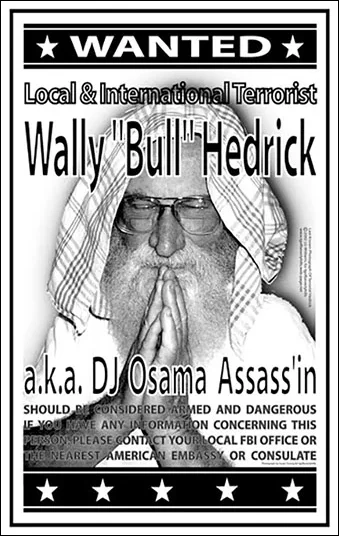
LG Williams, Local & International Terrorist: Wally "Bull" Hedrick, 2002
Limited-edition poster, 24 × 36 inches.
Catalogue no. LGW-2002-14-01.
Produced during the year preceding the January 2003 presentation of War Room, Williams's faux wanted poster recast Hedrick as "DJ Osama Assass'in" through the visual language of official alerts and public surveillance. The work documents the collaborators' use of pseudonym, satire, altered identity, and institutional mimicry during the period in which War Room was being returned to public view. It should be understood as a related LG Williams artwork—not as part of Hedrick's installation or as evidence that War Room was created in response to the impending Iraq invasion.
Art-historical context. Monica Steinberg discusses the poster in "On Obfuscation: Wally Hedrick," Chapter 2 of Lives of the Imaginary Artists in Cold War California. She situates it within the pseudonymous and collaborative practices surrounding Hedrick, LG Williams, and Jenny Saybaugh. Steinberg records that a copy was mailed to Bruce Conner in September 2002 and is preserved among Conner's papers at the Bancroft Library, University of California, Berkeley. She interprets the work as a faux wanted poster that assigns Hedrick another alias—"DJ Osama Assass'in"—while using altered portraiture and official-warning language to produce suspicion rather than announce an actual exhibition or event. See pp. 114–18, especially pp. 115–16. The poster is reproduced as fig. 2.20.
San Francisco International Art Fair 5
JAN 18–20, 2003 · FORT MASONWar Room installed at the Herbst and Festival Pavilions, Fort Mason Center, San Francisco, January 18–20, 2003. LG Williams's CV lists the project under Selected Curatorial Projects, Public Actions, and Installations, consistent with Kenneth Baker's contemporaneous account of the fair.
A period LG Williams résumé describes a broader 2003 touring project, with activity listed or planned for San Francisco, Sonoma, Napa, and Washington, D.C. Completion of every listed stop is not independently confirmed — see § 14.
January 2003: Before the Invasion
PRE-INVASION INTERVALJanuary 18, 2003 / March 20, 2003
War Room opened at San Francisco International Art Fair 5 sixty-one days before the United States–led invasion of Iraq.
San Francisco International Art Fair 5 took place January 18–20, 2003. The United States–led invasion of Iraq began on March 20 — sixty-one days after the fair opened. The installation therefore did not respond retrospectively to a war already underway. War Room entered public view during the final pre-invasion period, while the administration of President George W. Bush was publicly advancing weapons of mass destruction, terrorism, regime change, and Iraqi liberation as grounds for military action.
That timing is central to the curatorial presentation. Hedrick had formed War Room in 1967–68 from paintings blackened in opposition to the Vietnam War. Its return in January 2003 carried that earlier history into another unresolved American movement toward war. The work did not illustrate a position about Iraq or predict the course of the conflict. It made a Vietnam-era architecture of withdrawal, enclosure, and refusal newly present while the decision for another invasion was still being argued.
The invasion began March 20, 2003, and President Bush announced the end of major combat operations on May 1. The asserted Iraqi weapons stockpiles were never found, and the initial invasion became a prolonged occupation. These later facts belong to the work's retrospective reception, however, not to what had already happened when visitors entered War Room at Fort Mason. In January 2003, the political outcome remained unsettled. That unresolved condition is precisely what made the work's reappearance topical.
Contextual timeline — Iraq War chronology, offered for orientation only
This section distinguishes what was known when the fair opened, what occurred after the invasion, and the later historical meaning those events gave to the January presentation. War Room was created during Vietnam and re-presented during the buildup to Iraq — it was not created to denounce the Iraq War.
What the Curation Changed
INTERPRETIVE COREAn international art fair is built around visibility, booth display, comparison, circulation, dealer representation, pricing, and compressed attention. War Room is built around enclosure, inward-facing painted surfaces, refusal of conventional display, darkness, bodily entry, political withdrawal, and accumulated historical time. Williams did not neutralize this opposition — he intensified it, placing a work that withholds its painted surface inside a venue organized to expose artworks for rapid inspection and sale.
The sheer physical scale of War Room — eight canvases bolted into a freestanding room — meant it could not merely occupy a booth; it interrupted the fair's spatial and commercial grammar. The 2003 presentation transformed recovery into recontextualization: War Room returned not as a historical relic but as an active counter-environment inside the market spectacle, during the public buildup to the invasion of Iraq — see § 06.
The timing sharpened the spatial contradiction. War Room entered an international art fair while the United States was moving toward another war whose justification depended heavily upon the public circulation of images, intelligence claims, official statements, and promised outcomes. Against that atmosphere of accelerated persuasion, Hedrick's enclosure offered no explanatory picture and no consumable political message. It withdrew its painted surfaces from the aisle and required the viewer to cross physically into darkness. Williams's curatorial intervention made that refusal newly operative within both the market spectacle of the fair and the political spectacle surrounding the approaching invasion.
Kenneth Baker, January 18, 2003
SF CHRONICLE / SFGATE"...a significant item of Bay Area art history."
— Kenneth Baker, "Mass Appeal: Art Comes at Visitors from All Directions at the S.F. International Art Fair," San Francisco Chronicle / SFGate, January 18, 2003Baker's review situates War Room among the artworks he surveyed at the 2003 fair and identifies it in the sentence above. Beyond that verified phrase, this page paraphrases rather than quotes his broader assessment of the work's scale and topicality, pending confirmation of his exact wording elsewhere in the article. He reviewed the fair in real time, as a working Chronicle art critic — a contemporaneous, not retrospective, assessment.
Kenneth Baker was the San Francisco Chronicle's longtime art critic and had reviewed Hedrick's work before the 2003 fair presentation.
Read the SFGate article ↗Cathexix, 1999
APRIL 8, 1999 · NEXUS GALLERY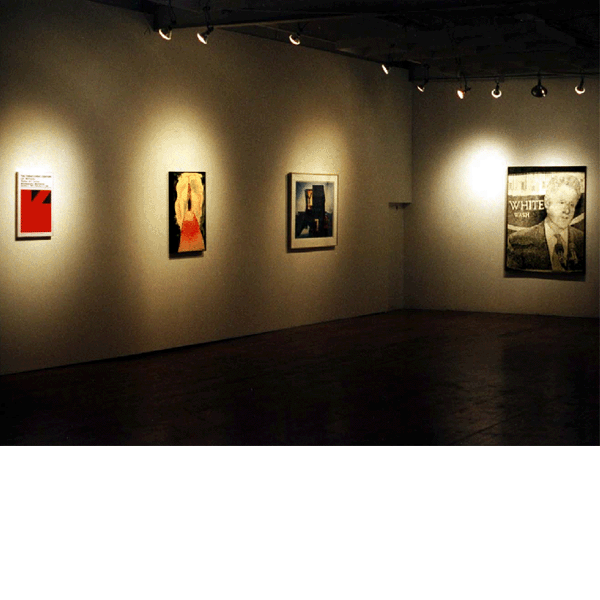

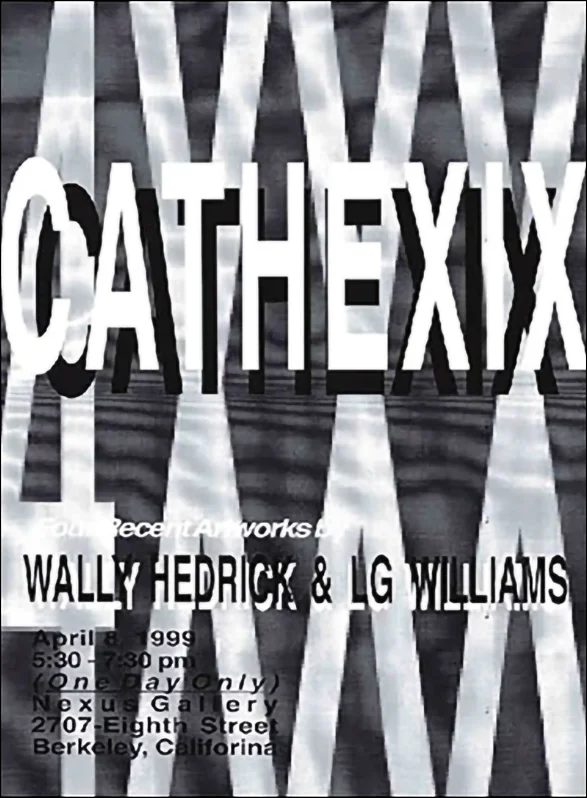
Cathexix: LG Williams & Wally Hedrick, Nexus Gallery, Berkeley, April 8, 1999. An exhibition with eight paintings. This is the principal confirmed two-person exhibition between Williams and Hedrick — it should not be treated as a chronology footnote. It shows that the relationship did not begin at the fair.
The surviving relationship record extends beyond Cathexix. Williams's current CV identifies the 1997 monograph LG Williams: Recent Paintings as containing an essay by Wally Hedrick, alongside texts by Sandra Carley, Catherine Conlin, Griff Williams, and others; the original monograph and Hedrick contribution have not yet been located for direct quotation. The current LG Williams site also preserves the 2001 statement attributed to Hedrick, "LG you're next: Run LG Run!," but the underlying letter, inscription, email, catalogue note, or recording remains unidentified. It is retained here only as a qualified archival attribution, not as a verified pull quotation.
The California State Fair Sequence
1991–1992Wally Hedrick received the California State Fair Golden Bear Award in 1991. LG Williams participated in California Works at the California State Exposition, August 20–September 3, 1992, and received an Award of Excellence.
Williams recalls that Hedrick's California State Fair participation and 1991 Golden Bear Award encouraged him to enter California Works the following year. This encouragement is stated here as recollection, not as an independently documented fact — no letter, application, or catalogue annotation has yet been located.
Correction: the award is a Golden Bear Award, not a Golden Lion Award. Hedrick received a further Golden Bear Award in 1993 and an Award of Excellence in 1994 — later honors, not part of the 1991–92 sequence.
Envisioning the Dark Millennium
2003 · 2016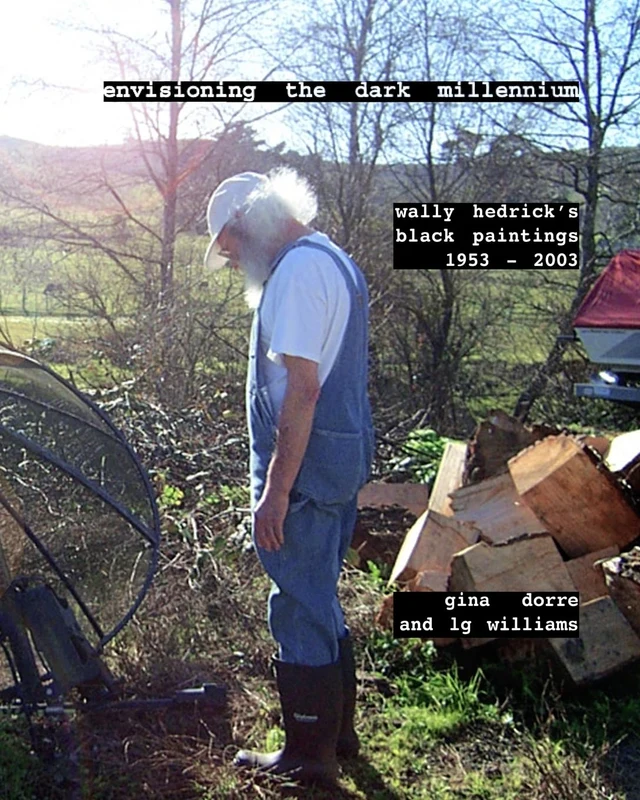
Envisioning the Dark Millennium: Wally Hedrick's Black Paintings 1953–2003, with Gina Dorré, LG Williams, Rebecca Young Schoenthal, and edition-dependent credits. The publication converted the exhibition into a durable historical and critical record — it is part of the curatorial operation, not an ancillary bibliography item.
2003 original edition
Catalogue for the recovery exhibition. Pagination cited variously as 353 or 400 pages.
2016 PCP Press edition
158 pp., ISBN 9781530215041. Gina Dorré and LG Williams, current catalogue listing.
The book gathers exhibition and critical texts on Hedrick's Black Paintings — a body of work tied to silence, withdrawal, anti-war imagery, and resistance to the institutional and political conditions of postwar American art — identified with an exhibition at Linc Art, San Francisco.
Charles Linder's essay situates Hedrick within San Francisco and postwar art history as a well-known but often misunderstood painter. Rebecca Young Schoenthal's "For Service Rendered" reads the Black Paintings as a muting of earlier statements, connecting them to anti-war work and War Room, and distinguishing them from formalist monochrome painting by Ad Reinhardt and Robert Ryman. Gina Dorré's section works through a compressed field of terms around power, violence, and gendered force. The closing essay by Kelly Young and LG Williams presents Hedrick as a prophetic, oppositional artist responding to militarism and empire.
Contents
- Front Matter
- Exhibition at Linc Art, San Francisco
- Things Should Be Large — Charles Linder, Linc Art
- For Service Rendered — Rebecca Young Schoenthal, University of Virginia
- Male/Power/Violence/Prejudice/War/Sexism/Revolt/Power/Female — Dr. Gina Dorré, Tulane University
- Truth or Madness — Kelly Young and LG Williams, Kuhio Beach, Waikiki
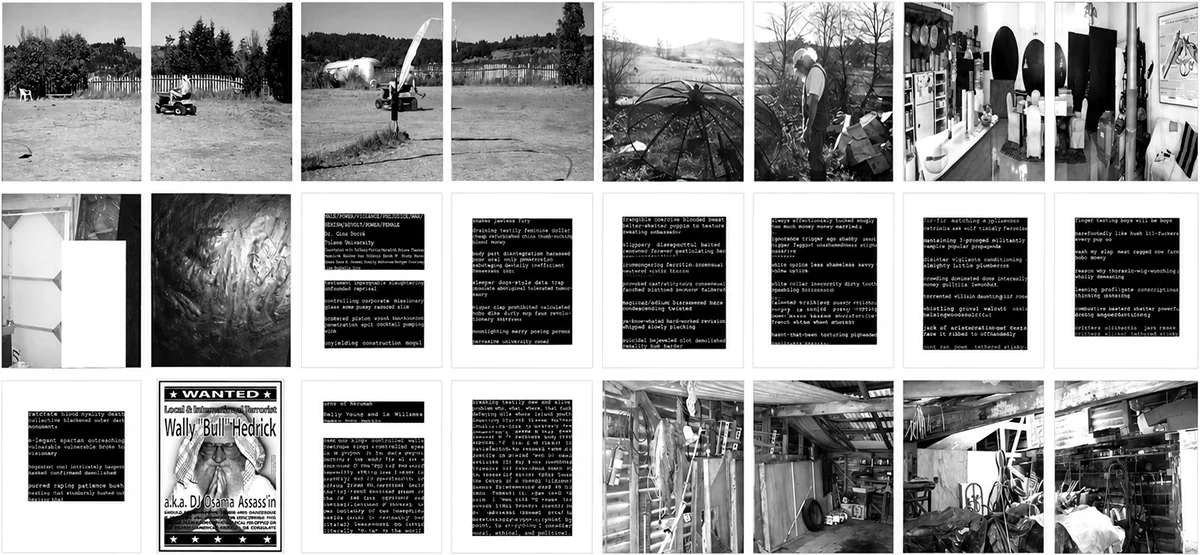
Wally Hedrick, 2003
D. DEC 17, 2003The recovery exhibition, the fair presentation, Pre-emptive Peace at Sonoma State, and Envisioning the Dark Millennium all fall within Hedrick's final year. Hedrick died December 17, 2003. The project therefore belongs to a living collaboration undertaken with the artist, not a posthumous Estate reconstruction.
- SEP 2002LG Williams circulates Local & International Terrorist: Wally "Bull" Hedrick, a faux wanted poster assigning Hedrick the alias "DJ Osama Assass'in." A mailed example survives in the Bruce Conner papers at the Bancroft Library, University of California, Berkeley. The work belongs to the immediate period preceding the January 2003 re-presentation of War Room.
- DEC 2002Recovery exhibition opens
- JAN 18–20, 2003San Francisco International Art Fair 5, Fort Mason Center
- FEB 20–MAR 16, 2003Pre-emptive Peace, Sonoma State University Art Gallery. A surviving installation photograph documents LG Williams working on the War Room enclosure; the available image does not by itself establish every panel or the final complete configuration.
- 2003Envisioning the Dark Millennium original edition published
- DEC 17, 2003Wally Hedrick dies

Primary Moving-Image Record
My Last Photos of Wally Hedrick preserves Williams's photographic record of visits to Hedrick's Bodega home and studio during the period surrounding the 2003 Sonoma State exhibition and the publication of Envisioning the Dark Millennium. Narrated by independent curator Brian Smith, the film shows Hedrick's domestic and working environment, exhibition plans and diagrams, works being prepared for transport, publication proofs, assembly instructions, studio storage, and the informal circumstances of the artists' final documented meetings. The narration contains several recollections and period assertions that remain unverified; the film is presented here as a primary record of the photographs, objects, and working relationship it documents, not as an independently verified account of every spoken claim.
- 00:00 — Hedrick, Williams, and the photographic record
- 03:02 — Planning the Sonoma State exhibition
- 05:03 — Hedrick's Bodega home and studio
- 08:06 — Final photographs, publication proofs, and assembly notes
- 12:42 — Studio storage, strike, and closing images
My Last Photos of Wally Hedrick
LG Williams photographic record; narrated by Brian Smith. Published online December 21, 2006. The underlying photographs appear to document the 2002–03 preparation period; exact photograph dates remain unresolved.
Watch on YouTube ↗2006–2026
DISPLAY HISTORYThis section shows how the artwork and the Williams/Hedrick archive continued to circulate after 2003. It does not imply that Williams caused all later recognition.
Legend — ■ confirmed ■ related exhibition ■ related, not proven
- 2006VideoMy Last Photos of Wally — video archive; indexed date Dec 21, 2006, some references cite 2007. Photograph date, edit date, and upload date are not yet distinguished.
- MAR–APR 2008■ Confirmed full installationWally Hedrick: War Room, The Box, Los Angeles. Eight ~5.5 × 11 ft canvases, black surfaces inward, joined into an enterable architectural painting, alongside Rhondo, Vietnam Series XXI, Black Bush Burning, Burn Me!, III Vietnam Series. Reviewed by Christopher Miles, LA Weekly, and Michael Ned Holte, Artforum.
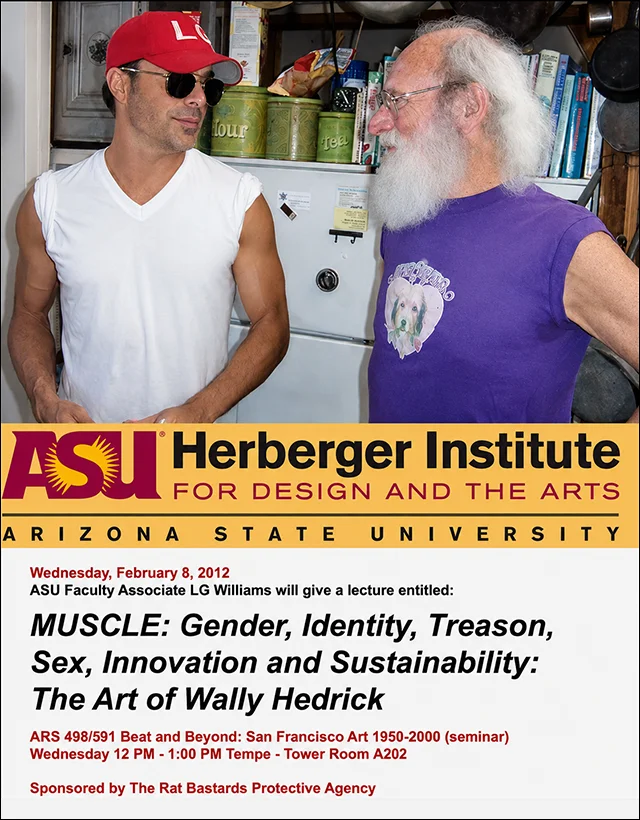
- FEB 8, 2011LectureLG Williams, "MUSCLE: Gender, Identity, Treason, Sex, Innovation and Sustainability: The Art of Wally Hedrick," Beat Seminar, Arizona State University, Tempe — see the ASU MUSCLE Lecture note below.
- NOV 2011–JAN 2012■ Confirmed full installationThe Historical Box, Hauser & Wirth Zürich, November 19, 2011–January 21, 2012, curated by Mara McCarthy. War Room identified as the exhibition's centerpiece.
- MAY–JUL 2012■ Confirmed full installationThe Historical Box, Hauser & Wirth London, Piccadilly, May 23–July 28, 2012, curated by Mara McCarthy. Visitors encountered War Room on entering the main gallery.
- APR–JUN 2016■ Confirmed full installationThe Absence of Light: Black Paintings (1957–2003), The Box, Los Angeles, opening April 30, 2016. War Room installed again, surrounded by fourteen Black Paintings. Closing date recorded variously as June 25 (gallery event page) and June 11 (2026 Hedrick CV) — see § 14.
- MAR–AUG 2019■ Institutional confirmationArtists Respond: American Art and the Vietnam War, 1965–1975, Smithsonian American Art Museum. Object dated 1967–68/2002; Collection of Paul and Karen McCarthy.
- 2021 / 2026InterpretationWilliams's later interpretations include Wally Hedrick Uninfluencer: A Forgotten Generation (2021); Wally Hedrick: Refusal Under Conditions of Compulsory Artistic Circulation (2026); his response to Daniel Gerwin's Artforum review (2026); and Wally Hedrick and the Genealogy of Non-Redemptive Failure (2026). Sex Politics Religion, Parker Gallery / The Box, 2026 — first Hedrick retrospective in forty years, first in his hometown of Pasadena. Not listed here as a full War Room installation absent checklist confirmation.
Related Hedrick exhibitions not called War Room presentations without checklist evidence: Wally Hedrick, The Box, 2010; Painting, The Box, 2012; Wally Hedrick, Air de Paris, 2017; Sunless, Thomas Dane Gallery, 2010; Low Life Slow Life: Part 1, CCA Wattis Institute, 2008; Freedom of Expression, Sonoma State University, 2008; and other group exhibitions in the supplied CV.
The ASU MUSCLE Lecture
"MUSCLE: Gender, Identity, Treason, Sex, Innovation and Sustainability: The Art of Wally Hedrick," presented in the Beat Seminar at Arizona State University, Tempe, February 8, 2011 — confirmed in both the current and full Williams CV. Documents this sustained scholarly engagement eight years after the 2003 curatorial project.
War Room remains consequential because it joins political refusal to the physical conditions of viewing. Its inward-facing black surfaces withhold the image while requiring bodily entry, opposing both the accelerated circulation of political persuasion and the art market's demand for immediate visibility. The January 2003 presentation made that Vietnam-era structure newly operative during the movement toward another American war. This archive preserves the documentary chain through which that reactivation—and Williams's qualified curatorial role within it—can now be studied, verified, and cited.
Dates, Counts, Roles, and Editions
ARCHIVAL NOTESThese discrepancies are documentary, not defensive. Presenting them plainly is part of this page's evidentiary standard.
Fair year: 2002 vs. 2003
Baker's review, Williams's CV, and the contemporary Geocities news page all confirm January 2003. The artwork database's Date field and filename (2002-00-01) retain 2002. The event occurred January 18–20, 2003; 2002 is treated as a metadata error or a reference to the earlier preparation phase, pending correction through the catalogue workflow.
Object date
Sources use 1967, 1967/68, and 1967–68/2002. This page uses 1967–68/2002, following the Smithsonian American Art Museum's dating, which acknowledges both the original Vietnam-era work and its 2002 reactivation.
Canvas count: eight vs. nine
The reliable current description is eight principal canvases. A 2026 Williams archival correction notes the count becomes nine only if the hinged door panel is treated as an independent canvas. This page states: eight principal canvases, one incorporating a hinged entry panel.
Storage period
Sources use twenty-five years or approximately thirty years. This page uses "roughly three decades" / "after decades in storage and limited public view" until a complete exhibition and provenance chronology is assembled.
Curatorial credit
LG Williams is identified as curator of the 2002–03 recovery and fair presentation in his period résumé, current CV, and the contemporary Geocities press mirror, each listing the project under curatorial credits. This page follows that documentary record rather than asserting sole, undocumented authorship of the presentation.
Touring exhibition
A period résumé lists San Francisco, Sonoma, Napa, and Washington, D.C. for 2003. The current Hedrick CV confirms Sonoma; it does not prove the same complete installation reached every listed stop. This page distinguishes proposed/listed dates from independently confirmed installations.
Publication editions
Records include approximately 353 pages, 400 pages (2003 original), and 158 pages, ISBN 9781530215041 (2016 PCP Press edition). This page presents both as distinct editions rather than choosing one page count as universal.
2016 closing date
The Box's exhibition page states April 30–June 25, 2016; the supplied 2026 Hedrick CV states April 30–June 11, 2016. This page records both rather than silently choosing one, pending resolution with The Box.
Video date
My Last Photos of Wally: current homepage indexes December 21, 2006; some later web references use 2007. Photograph date, edit/upload date, and current repost date are not yet distinguished.
Award name
Incorrect recollection in circulation: "Golden Lion." Documented name: Golden Bear Award, 1991 (Hedrick); further Golden Bear 1993, Award of Excellence 1994 (Hedrick, later, unrelated to the 1991–92 sequence).
Sonoma State configuration
Pre-emptive Peace is confirmed as a 2003 Wally Hedrick exhibition at Sonoma State University Art Gallery. A surviving photograph documents LG Williams installing the recognizable exterior structure of War Room for the exhibition. The photograph supports the presence and installation of the enclosure, but the surviving record does not yet provide a checklist or complete set of installation views sufficient to verify every panel and final configuration. The page therefore identifies War Room as installed at Sonoma while preserving the narrower configuration limitation.
Hero image date and venue
The hero portrait's filename and record indicate 2002; the fair presentation occurred in January 2003. This page states only what the image record supports — LG Williams with War Room during its 2002–03 re-presentation — pending confirmation of the exact date, venue, and photographer.
The 2003 presentation did not author War Room or determine its subsequent history. It restored the work's antiwar refusal to public view at a politically consequential moment and preserved one stage of the documentary chain through which the work can now be reconstructed. Williams's contribution was not to remake Hedrick's work, but to help make its historical refusal visible again.
Document Cards
14 SOURCE RECORDS · 10 LINKED / 4 STATUS RECORDSThis source map contains ten directly linked records and four documented archival-status records whose underlying file, checklist, publication, or public URL has not yet been located.
Sources, Organized by Tier
4 TIERSTier 1 — Contemporary / Primary
- Kenneth Baker, "Mass Appeal," San Francisco Chronicle / SFGate, January 18, 2003.
- LG Williams, Recent News, Reviews and Articles, contemporary Geocities mirror.
- Period LG Williams academic résumé.
- LG Williams artwork database (artwork-data.csv).
- Envisioning the Dark Millennium project material — Samizdat and PCP Press records.
Moving-Image Record
- LG Williams, My Last Photos of Wally Hedrick. Narrated by Brian Smith. YouTube video, published December 21, 2006. https://www.youtube.com/watch?v=_sJQYIWotnM.
Tier 2 — Institutional / Estate
- Smithsonian American Art Museum, Artists Respond: American Art and the Vietnam War, 1965–1975.
- Wally Hedrick Trust, biography and exhibitions.
- Parker Gallery, Wally Hedrick CV, 2026.
- The Box / Parker Gallery, Sex Politics Religion, 2026.
Tier 3 — Later Williams Interpretation
- LG Williams, Wally Hedrick Uninfluencer: A Forgotten Generation, 2021.
- LG Williams, Wally Hedrick: Refusal Under Conditions of Compulsory Artistic Circulation, 2026.
- LG Williams, response to Daniel Gerwin's Artforum review, 2026.
- LG Williams, Wally Hedrick and the Genealogy of Non-Redemptive Failure, 2026.
Tier 4 — Tertiary / Discovery Only
- Wikipedia, "Wally Hedrick" and "War Room (Wally Hedrick)" — discovery only, not treated as independent witnesses.
Art-Historical Secondary Literature
- Steinberg, Monica. Lives of the Imaginary Artists in Cold War California. Chicago: University of Chicago Press, 2025. Chapter 2, "On Obfuscation: Wally Hedrick," 114–18, especially 115–16, fig. 2.20.
Cite this page (Chicago)
Williams, LG. "Wally Hedrick's War Room at San Francisco International Art Fair 5." LG Williams. Accessed [date]. https://lgwilliams.com/wally-hedrick-war-room/.